• Skip to main content
  • Skip to footer

The Days Forward

West Point Class of 1969

  • Starting Out
    • Reception Day
    • Making the Cut
    • Becoming a Cadet
    • Where Did They Go?
  • Browse the Stories
    • Authors
    • Map
    • Search
    • Archive
  • Contact

Suzanne Rice

Jan 04 2020

Destination Alaska – 1970

I didn’t meet Harold Lee Maxson (called Tub) until he was close to the end of his years at West Point. Tub and I would have been married 50 years this year. I was headed for an entirely different life before I met Tub. I was studying Fashion Merchandising in New York City and fully intended to have a buying career that I hoped one day would take me on wonderful buying adventures – my ultimate goal: time in Paris.  Little did I know that before any of that came to pass, I would meet my soul mate and the adventures that I would eventually go on would be far superior to anything I could have ever imagined.

My father and all of his brothers served in the military during World War II and there was always a reverence for the military in our family that I came to respect as I grew up, but I never thought that other than our family history I would have any direct connection to the Army.

I met Tub by default at the Army/Navy Game in 1968.  I was not supposed to be his date.  I have to say the minute he walked into the room I was smitten.  I came from a large Irish family, so I recognized his as a handsome Celtic face and he had the most engaging smile. After a bit, we started dating.  As a result, in June of 1969, I was there with him to celebrate “June Week” and his graduation.
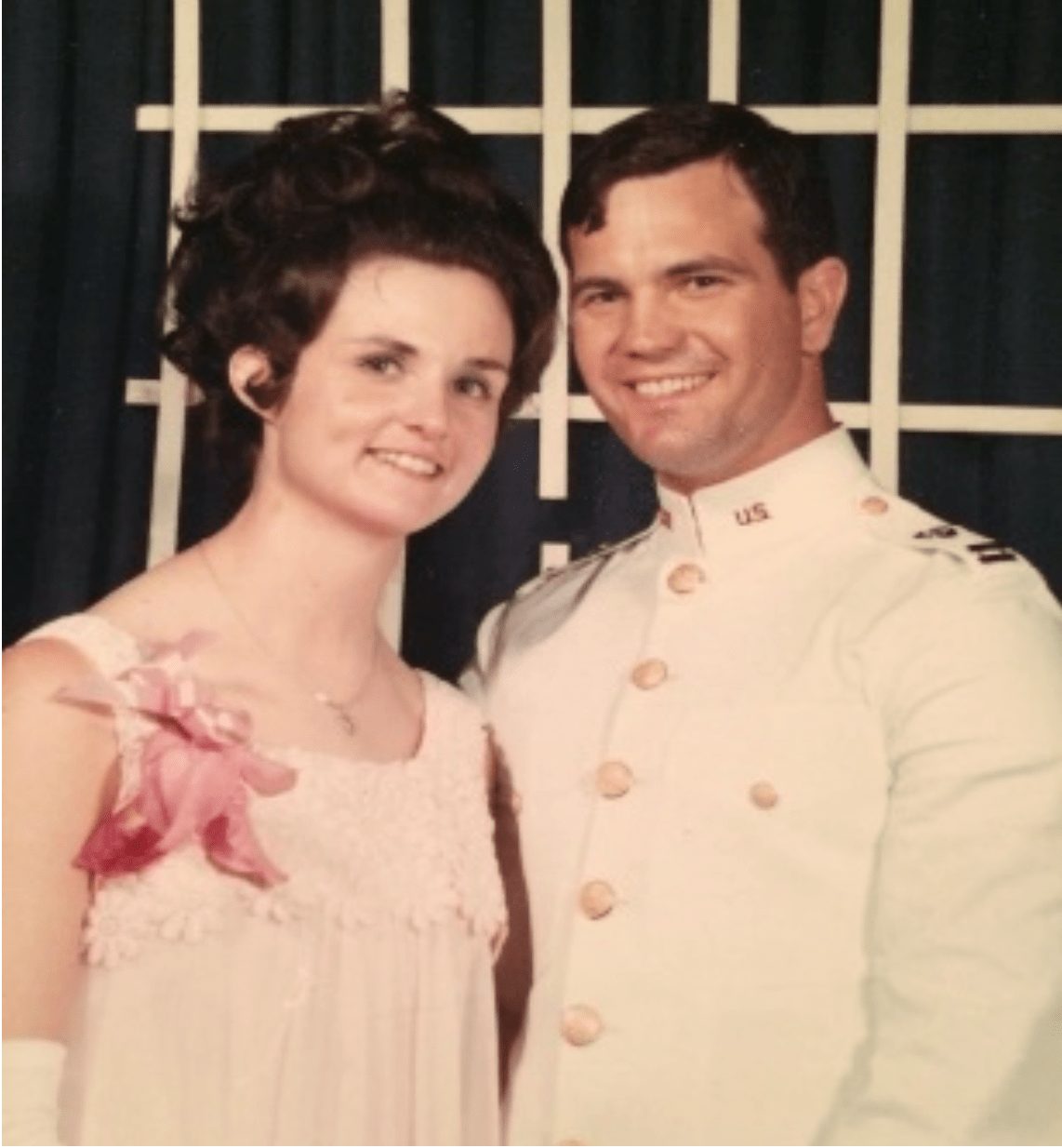
June Week 1969

That is most likely where our story begins.  Tub drove me back home to New Jersey after graduation in his shiny new AMX.
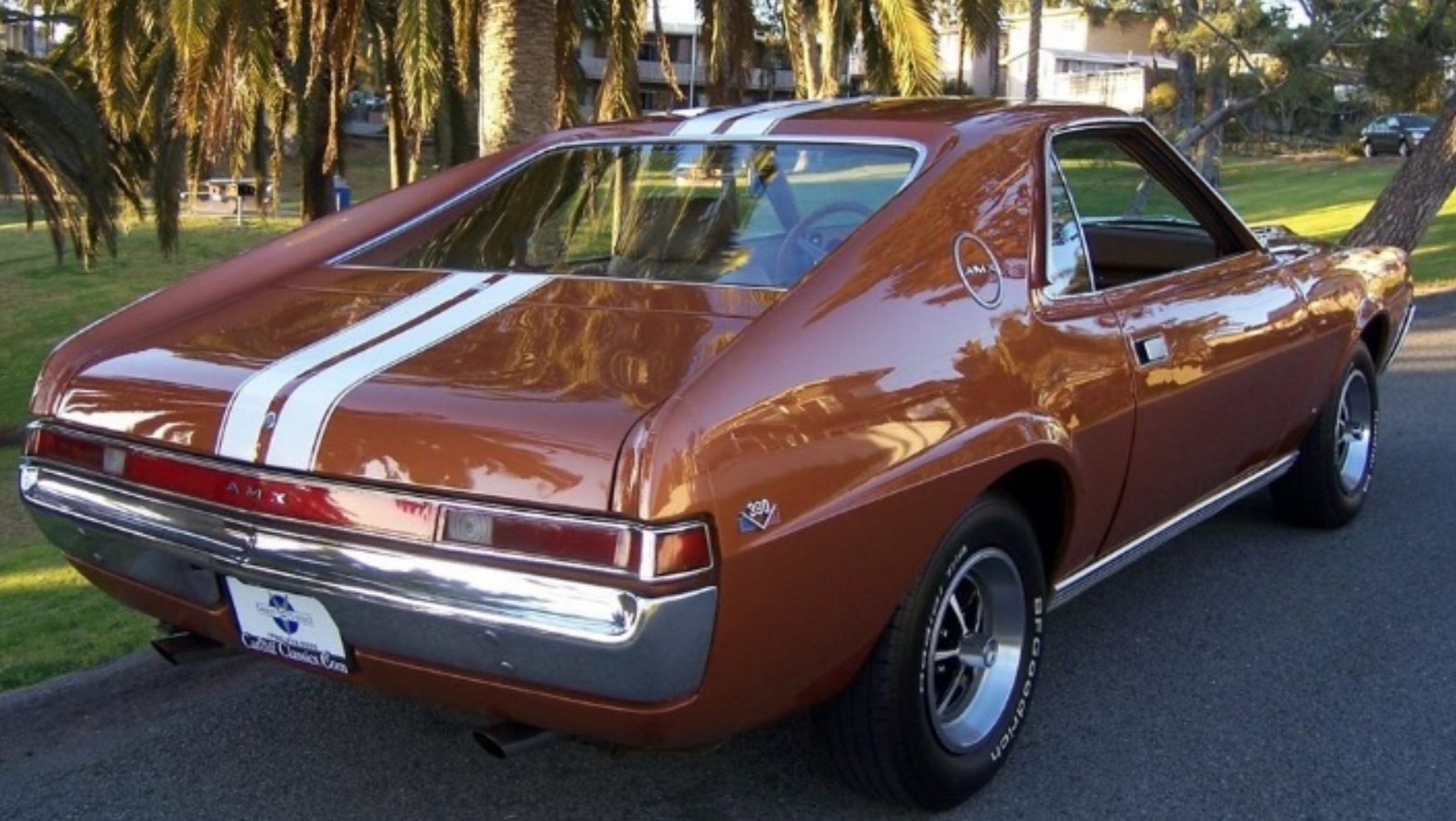
Tub’s brand new AMX

He had planned to stay a few days at my parents’ house.  The time turned into most of the summer.  My family was beginning to wonder if this was becoming serious.  I knew it wasn’t, He would be going to Alaska with a stop at Fort Benning.  He had dreams of getting a motorcycle and an English Bull dog and seeing the world. His future was set.  Although I was hoping for Paris, I had been offered a job in the buyer training program at Best and Company, a department store on 5th Avenue in New York.  I thought i was going to accept it.

One evening in July, Tub and I decided to go to a drive-in.
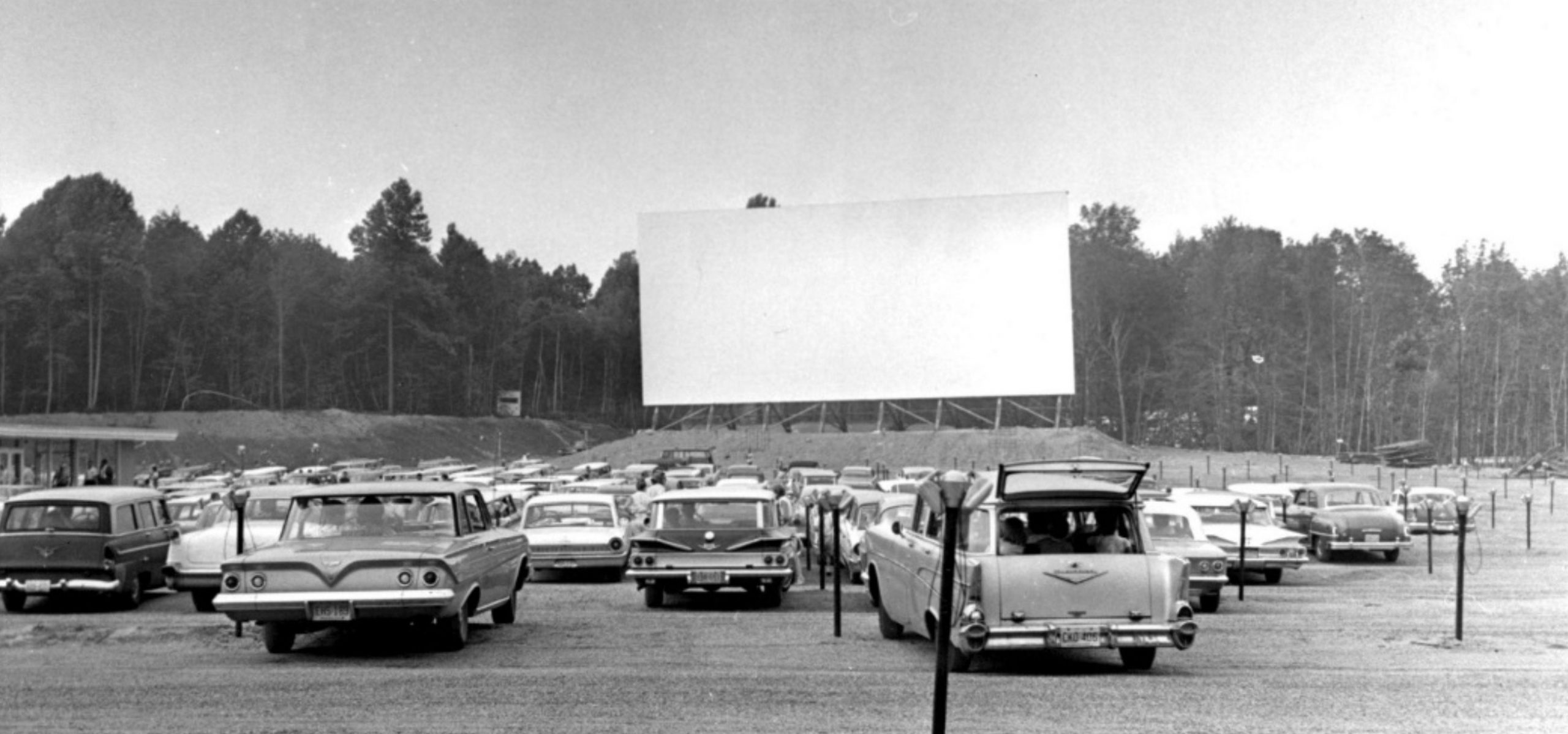
Waiting for dark so that the movie could start at the drive-in

I loved movies and since I didn’t have a car, drive-ins were a special treat. Somewhere in the course of the evening Tub asked me to marry him. The problem…I was not expecting it and I missed it entirely.  For days after he was annoyed with me, but I had no idea what I had done.  Finally, he said, “You could have said something.”  I had no idea what he was talking about and after some convincing, he realized that.  Lucky for me he asked again and instead of taking the job I took a leap of faith.

We decided to get married in February but with orders changing and leave availability we decided on an earlier date in November.  We were married on a three-day pass and by Monday, Tub was back in the field at Fort Benning.  I really missed my large family, but it was not long before I realized I had become part of another family not related by blood but by purpose and friendship. The military that I had grown up respecting was now part of my life. Our next assignment would be Alaska and some of the friends we knew in Georgia would be joining us there.

We left Georgia for our drive across country, to the state of Washington, in late winter; there we would fly to Alaska. After stops in New Jersey and Michigan to visit our families we began our trek West.
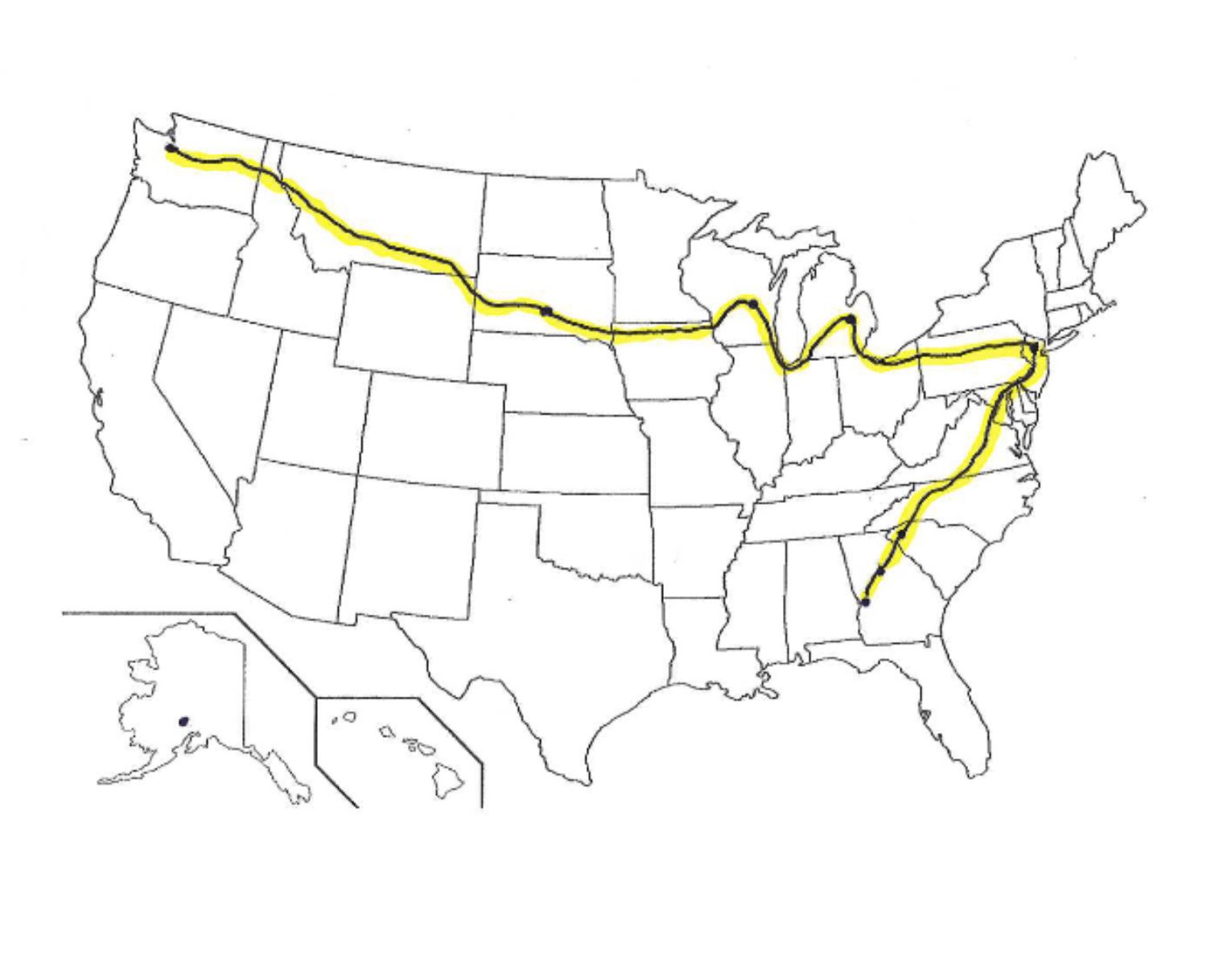
Heading from Georgia to Alaska

I had never been further west than the Dakotas and Tub had always wanted to go to Alaska.  We were so excited to be making this trip.  Had Willie Nelson already written the song “On the Road Again” it might have been our theme song. “On the road again, just can’t wait to get on the

road again…” The changing terrain was beautiful sometimes blanketed with snow. The small towns, the big cities, the open land, it was a joy to see.  Gosh, what is that? I’m excited. On a practical side, we were traveling with some cash, traveler’s checks, and a gas credit card.   

Travelers Checks in several denominations

In those days, credit cards were not readily available and we didn’t qualify.  We were also traveling with two dogs. Tub gave me a Miniature Schnauzer as a wedding present and we acquired Cinnamon Cinder the 11th, a Miniature Dachshund, while in Georgia.  Since we were practical and poor, we decided to travel with an electric fry pan and a cooler.  How much simpler life would have been if smart phones had been invented and we could have found a list of hotels that accepted pets and credit cards to pay for dinners out, but it would not have been nearly as much fun.  So, each night Tub put the dogs in his coat, and I carried the fry pan and the food. This was our nightly version of covert ops and we hoped we would not be discovered. The next morning, we were “On the road again”.

When I think of arriving in the state of Washington, I think of a mountain pass covered in snow with beautiful large birds that may have been pheasants and thinking that I wished I could capture that moment. I don’t remember where Tub had to check in, maybe Ft. Lewis; the logistics of the second leg of our journey were in his purview not mine.  I became more engaged in the process when his paperwork stated that since Alaska, at that time, was considered an overseas assignment, his dependent had to be given the required injections for said assignment.   I remember getting shots in both arms and shortly after I was sick.  I was so sick that I could not leave the hotel room to get to a medical facility – that lasted for three days.  We were quickly running out of money. I’m sure Tub was frantic, but he had to get our dogs and car shipped and rearrange our flights until I could travel again.

I don’t know if it was the original flight plan, but we flew to Alaska in what I believe was a C-130; I remember a cargo net in the front of the plane that appeared to be holding luggage.

Travel to Alaska

Someone said that they put regular seats in for the flight.  I was new to this and at the time I didn’t know what irregular seats might have been.  We would have been able to buy a box lunch but after the extended hotel stay, we had 30 cents between us. We didn’t know what would happen when we eventually arrived in Alaska with 30 cents in our pockets and no car but one chapter of our adventure had ended and the next was about to begin.

Fortunately for us, the heavens and the military realized that the exuberance of youth and 30 cents was not going to do it for us, and we had been assigned sponsors.  They met the first three planes, and this was the last one they were going to meet before concluding that we were not coming.  They were such a welcome sight.  They took us to the post guest house at Fort Richardson and promised to take us the next day to see the sights and look for moose. I don’t remember the first few days there and I don’t remember their names because I was still decidedly unwell.  I do remember the fleeting thought when I got off the plane: Oh! there is the tarmac and mud along with snow. I knew nothing about Alaska. I thought I was going to be landing on something akin to an iceberg. I had no idea what we were coming to since this was before the advent of the internet. The written word was not adequate to describe what we would find in Alaska. Our time there witnessed magnificent scenery, new directions, lessons learned for me about the military,  a motorcycle, camping in the wilderness while six months pregnant, camping on a glacier (Tub) one of his oft told stories, babies born, joys, sorrows and news of friends tragically dying.

We grew up a lot there. I was 21 and Tub 22 when we left Georgia. The kids who drove across country young and bulletproof left Alaska as adults. We were a bit older and considerably more aware.  We were also the parents of a wonderful baby girl.
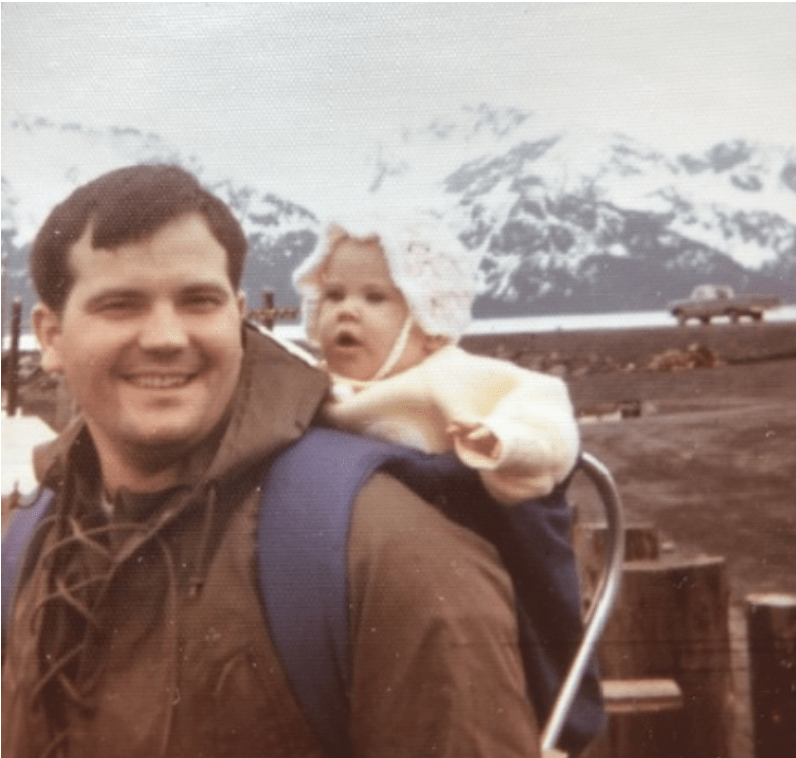
Tub and daughter in Alaska

In the 47 years that I was blessed to have with Tub, there were countless more adventures.  He had several motorcycles and many trips on them through the USA, Canada and parts of Europe.
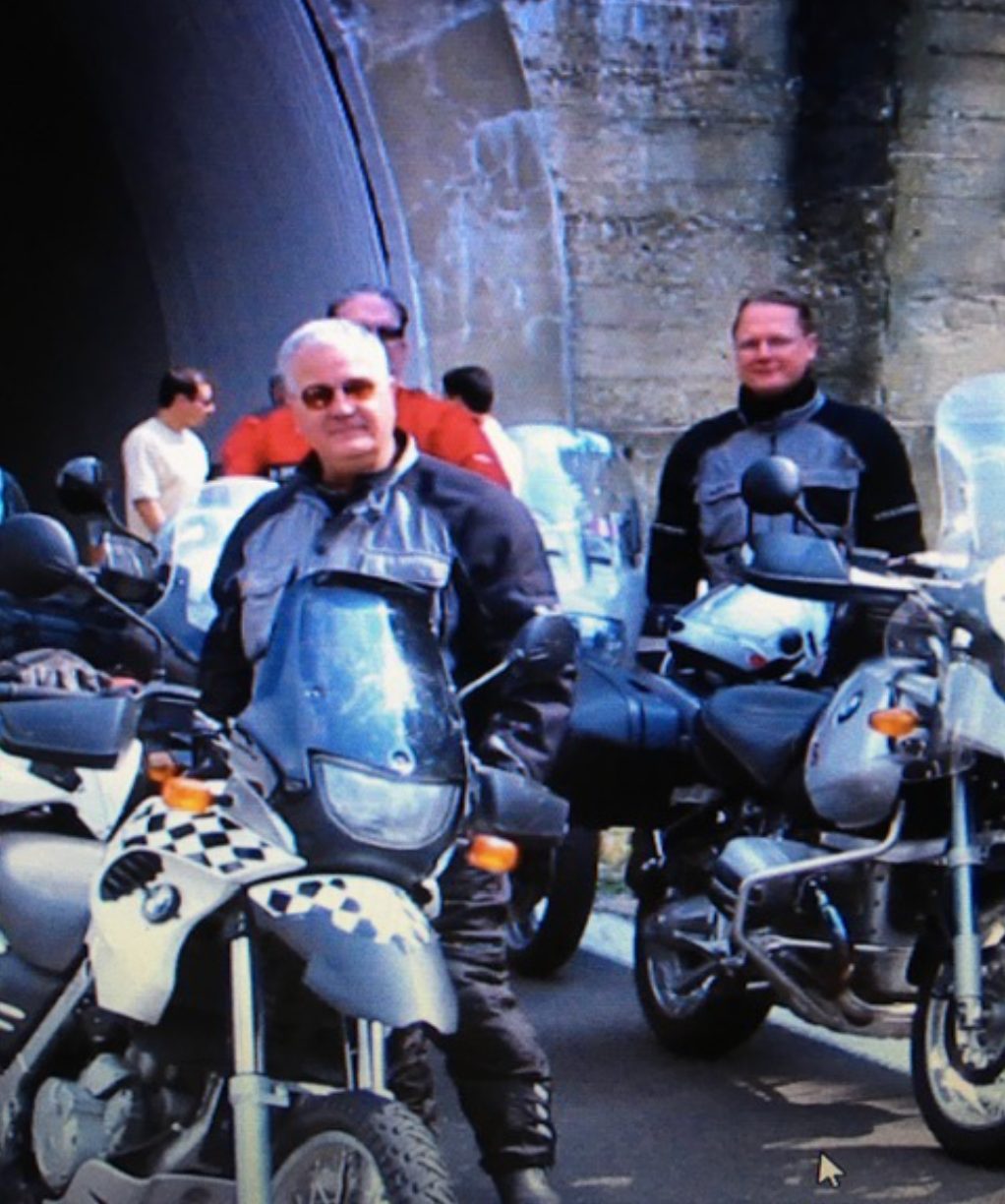
Tub with German friend, Michael

I eventually got as far as a layover in the Paris airport and for a brief time I was a buyer for a small store in PA. The cross-country trip and Alaska were really where my interest in art began and has remained. I discovered that art and life are all about capturing the moment.

I often think in terms of song lyrics, just lines from songs where the bits and pieces fit the situation. In writing this I keep thinking of a song by Ronnie Milsap, “I Wouldn’t Have Missed It for the World”. With a few changes to reflect how I felt about my husband and our life together. “I wouldn’t have missed it for the world, wouldn’t trade one memory. You made my whole life worthwhile with your smile…I wouldn’t have missed it for the world.”

Forever and always,

Cyn

Written by Suzanne Rice · Categorized: By Cindy Maxson

Dec 15 2019

West Point, Army Doctrine, and Boxing – 1991

Our class went through four years of West Point figuring that it was preparing us for a career of traditional military service.  That assumption was essentially correct, although in our lack of depth of understanding of what was “traditional” we were endlessly surprised in the years that followed by exactly what our duties entailed.  As it turned out, you see, the only tradition we should have expected was dealing with the unexpected.  However, West Point had done its job well and when the time came most of us figured out what to do and got it done.

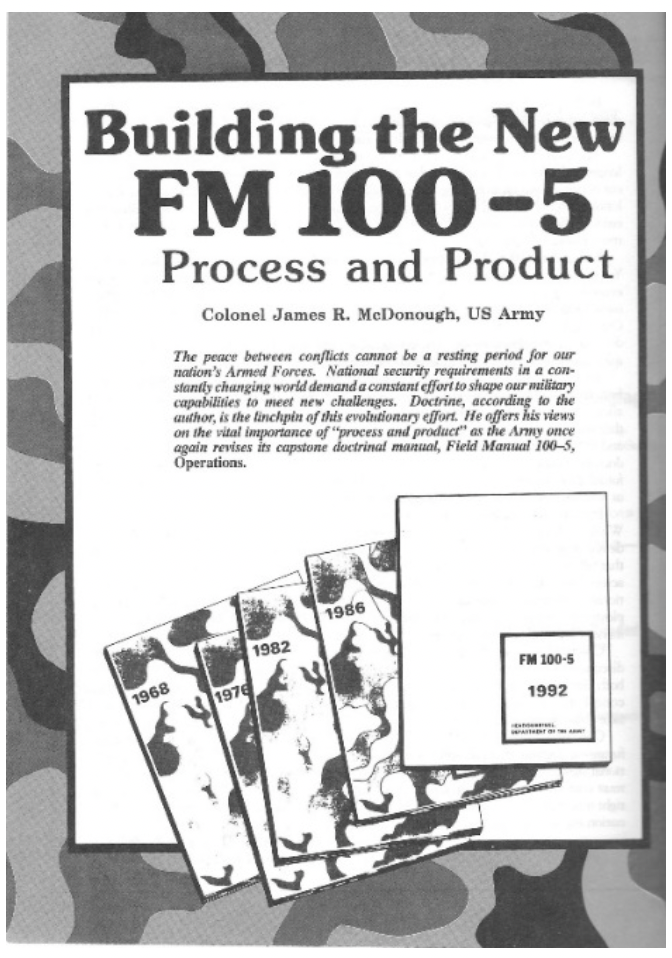
I had a few such moments, but one of the more interesting was being tagged to draft the operational doctrine for the Army.  The Army produces tons of doctrinal manuals, but the keystone of all those ton is its central warfighting manual, known throughout the 20th century as Field Manual (FM) 100-5.  The military is one of the two great institutions that takes its doctrine seriously (the other being the church) and no branch of the military takes it more seriously than the US Army.  Hence, it is modified only every few years and only after much consideration and debate, heavy bureaucratic infighting in the competition of ideas, and ultimate directive of the Chief of Staff of the Army.  Once approved it will dictate the Army’s organizational structure, major equipment procurements, branch integration, soldier training, and officer education for a decade or more.

Shortly after the end of the 1991 Gulf War, I was assigned to Fort Leavenworth to be the Director of the School of Advanced Military Studies (SAMS), where I had been a War College Fellow a few years prior.

Mens Est Clavais Victoriae
School for Advanced Military Studies (SAMS)

Soon thereafter, General Gordon Sullivan became the Army Chief of Staff and, subsequently, General Fred Franks (newly promoted) became the Commander of Training and Doctrine Command (TRADOC).  Franks’ subordinate for the overall development of doctrine would be then Major General (later General) Wes Clark.

I suspected that drafting a new 100-5 would be part of my assigned duties.  A former director of SAMS (then Colonel Huba Wass de Czega) had drafted the 1980s versions focused on AirLand Battle.  But by 1991, the Soviet Union had dissolved, and the United States was facing new types of threats and challenges around the world.  So, having written a book on leading a platoon, it was only natural that I would be the drafter of the keystone doctrine, an extra duty that would consume the better part of three years.  And so, it was to be (big “Gulp!” here).

The Army gave me all the help I could possibly need.  I was given full support in picking a crackerjack team of six fine officers from around the Army (one of whom was our classmate, Gary Steele).  I also had able input from the available student talent at the school – extremely competent War College Fellows (including classmate Bill Rice (https://thedaysforward.com/bill-rice), the bright young SAMS officers (captains and majors) who were chock full of good ideas, and a brilliant faculty of experts at Leavenworth on the operational level of war.  Immediately, General Sullivan put out a call for input from his senior generals and all branch chiefs and opened the door to retired general staff officers as well.  Add to that the team at TRADOC (who had a strong interest in what came out), and perhaps most importantly the keen interest and leadership of General Sullivan and General Franks (both of whom were personally involved and who shielded me amongst the rough of tumble of contending ideas between high-ranking and often iconic senior officers).

All the above took part in the building of the final product.  SAMS students, for example, were invited to offer ideas, provided they wrote a short paper arguing their point(s).  Then other students would be invited to take an opposing view and a group of them would debate the two sides.  If an idea so offered was worthy, it very well could enter a draft. At a much higher level, the Chief of Staff and TRADOC commander would host various meetings of senior officers (e.g., Army Staff 3-stars, Branch Chiefs, four-star commanders, and others) where yours truly would offer up the drafts to that point (usually written and circulated in advance) and brace himself for the feedback (not always glowing commentary, as it happened).

Retired senior officers were not at all shy about offering their views, in a variety of ways. My favorite among the latter was LTG (R) Jack Cushman (First Captain, West Point Class of 1944) who called one morning and suggested I go to the Leavenworth archives and review his writings.  Accustomed to such calls, I showed all proper military protocols and promised I would.  He then called the following morning (at 0700) and asked me what I thought of them, whereupon I confessed I had not yet been to the archives.  The following morning at 0700 when the call came, I was ready.  His input was wonderful, I must say.  He had a penetrating grasp of the Army and its doctrine.  One paper of his, penned in 1956, dealt with the concept of “air-land battle” (27 years before it entered FM 100-5).  He and many others had great input to the doctrine.

None of this was done in the shadows; there were no hidden agendas.  Successive drafts were shared endlessly.  As we neared the end, a part of the job was to sell the product (Gary Steele was a star here – https://thedaysforward.com/gary-steele-tight-end-army/), not just to the Army and our sister services and our allies, but to the public as well, both via the media, publications,  and in various forums (one, for example, being John Lucas’ law firm in Richmond).

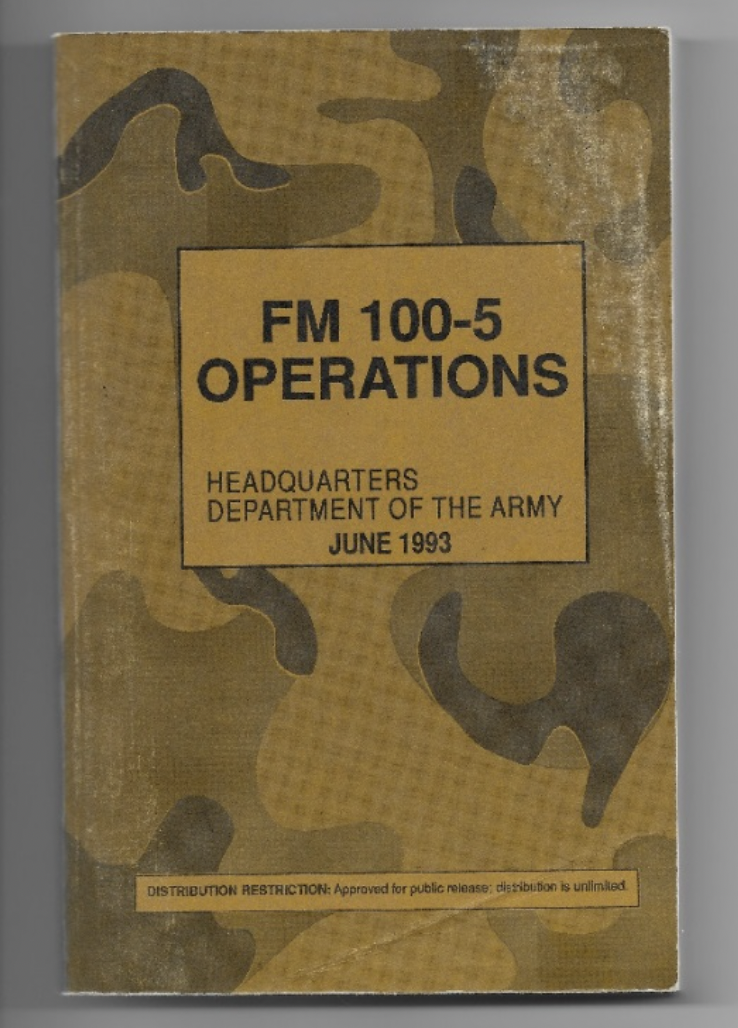
With such leadership from the top down, a well-resourced team effort, and endless debate based on the collective experience of all involved, the 1993 version of its operational doctrine set a new course for the Army as it closed the 20th century and entered the 21st.

The Finished Product – 1993

Okay, so then why is boxing in the title of this essay?

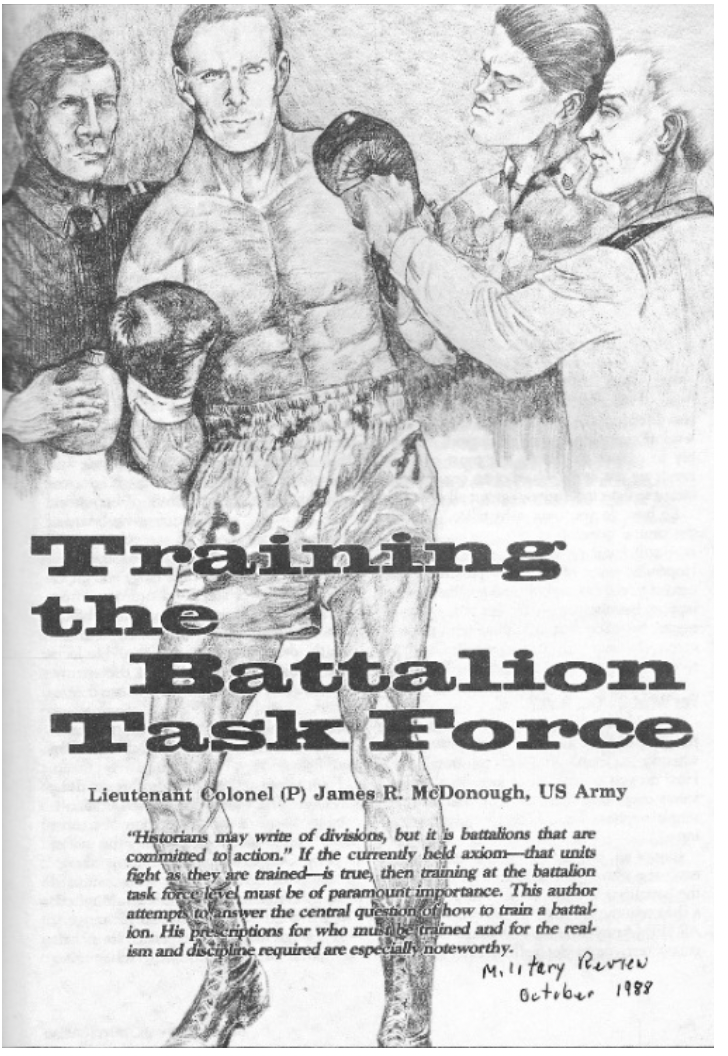
Military Review 1988

Well, you see every written effort must have a central concept that ties the entire body of work together – even if that theme is not explicitly articulated in the body of work.  In this case, the objective was to formulate the Army’s central warfighting doctrine.  While that effort encompassed many of the best thoughts of military theorists, historians, combat experienced generals, and other experts over the centuries (without being named in the text), my own touchstone was the three principles of Plebe boxing – the ability to move, to hit, and to protect.  They must be conquered in various combinations and sequences (hit, move, protect; protect, move, hit; move, protect, hit; and so on) and they must have the proper supporting systems (communications. intelligence, training, logistics, etc.) and apply the timeless principles of war (unity of command, mass, economy of force, etc.).  But in the end, warfare remains the ability to hit, move, and protect.

So, for those of you who thought Plebe boxing was just a physical torment to add to the tribulations of our first year at West Point, it was really a deep academic subject full of profundities that we could call upon in our future years as we dealt with the many challenges that the Army introduced us to.  It was a truism I kept from everyone else during the effort, of course, but now you know the rest of the story.

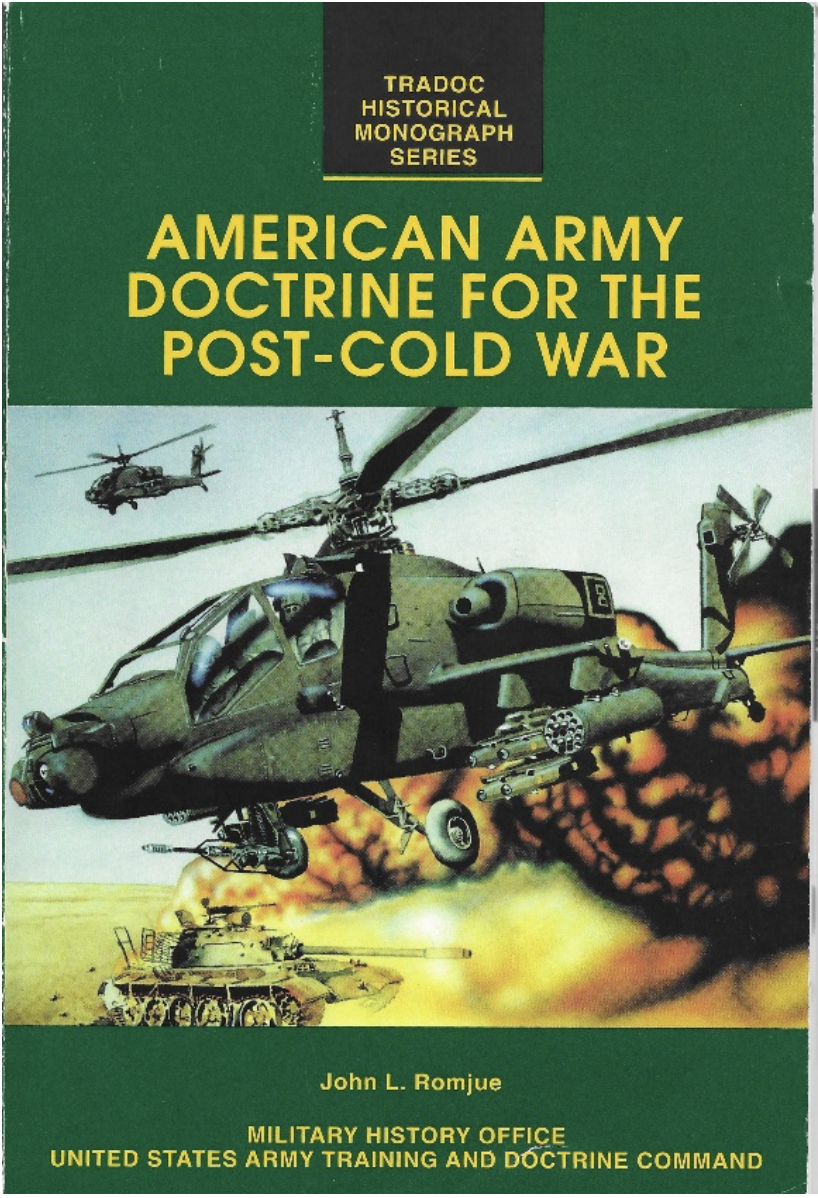
Editor’s note:  For those who would like to know more, you may go here; click on the cover photo to read more:  https://www.google.com/books/edition/American_Army_Doctrine_for_the_Post_Cold/qXKyv6Q2Dl8C?hl=en&gbpv=1&pg=PP1&printsec=frontcover


Read General Frederick M. Franks Intro


Written by Suzanne Rice · Categorized: By James McDonough

Nov 22 2019

Predicting Year 2000 – 1989

Recently, I was looking for something, rummaging through some storage boxes in the basement. Before I found what I was looking for, I ran across an old work folder from the ‘80s. One of the items in the folder caught my eye, an internal corporate newsletter, dated 4th Quarter, 1989. In it was an opinion article written by me, which I had long since forgotten.

At the time, I was the manager of an internal computer consulting department for The Coca-Cola Company in Atlanta. In those days, computers were still being deployed to desktops. We had not yet reached the point where a computer was considered an essential part of every professional employee job role. The department’s mission was to promote and assist in increasing employee and company productivity through increased use of computers. The newsletter was actually produced by my department and focused on computer topics for the edification of employees.

The article began with a perspective on the amazing growth of computer technology in the ‘80s. Then, it looked toward the new millennium – only 10 years away. What might it have in store for us? So, in the rest of the article I made some predictions regarding what we might expect in the way of computing technology advancements by the year 2000.

In re-reading the article I found myself drifting into a somewhat retrospective state and I began to reflect back to the beginning of my career interest in computers. That took me all the way back to Cow Year at West Point. One of my courses that year was titled “Computer Science Fundamentals”.

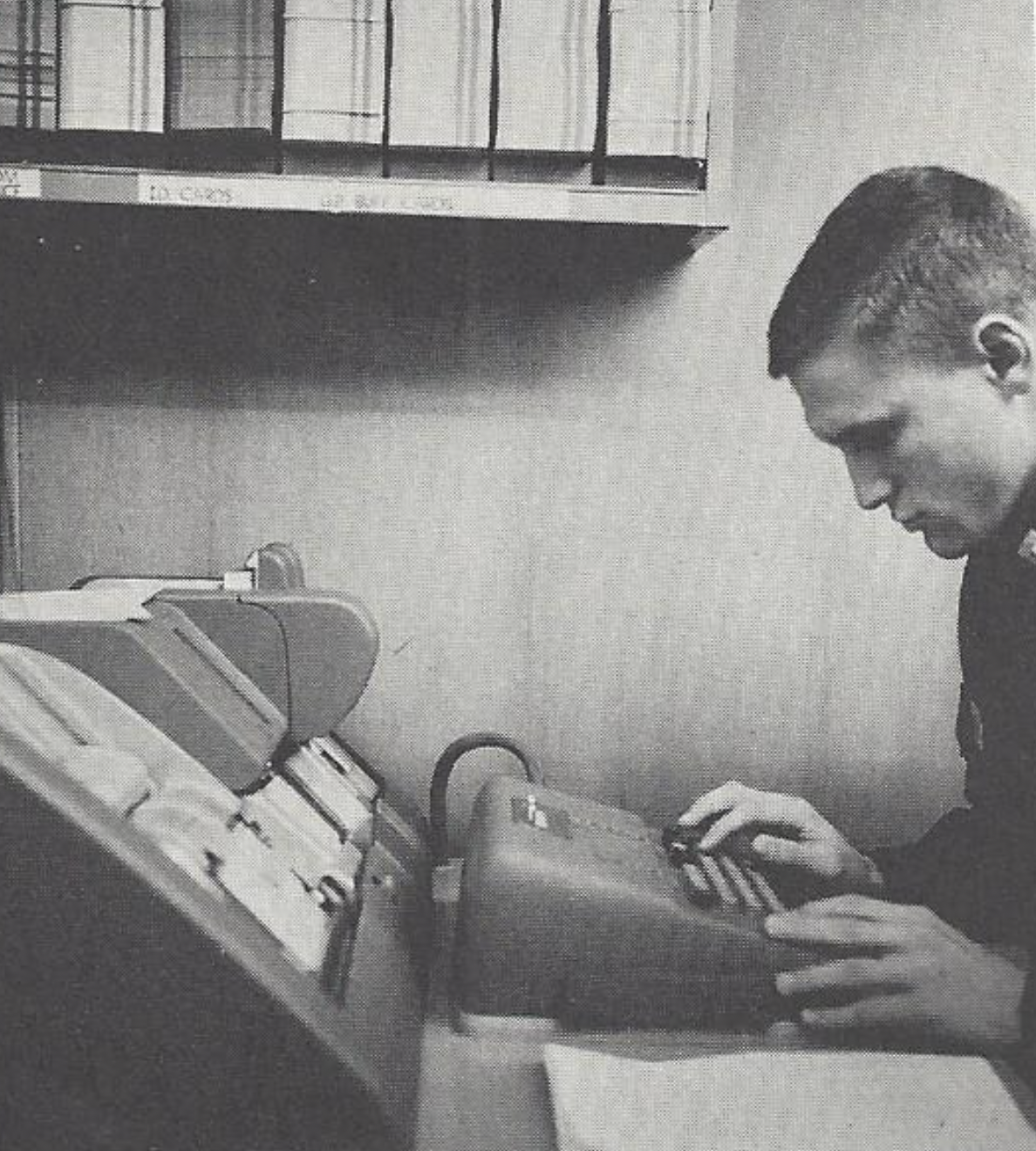
Cadet Keying Program
Cadet keying program into punch cards

I think it was an elective course, but it may have been one of the core courses that we all had to take, can’t remember. It basically consisted of learning FORTRAN language programming, although the Academy referred to it as “CADETRAN”. Anyway, I really liked it and found that I had some talent for it. I made a mental note that the computer field might be something to pursue after an Army career.

Fortran Computer System 1970s
Computer punch card of the 1970’s

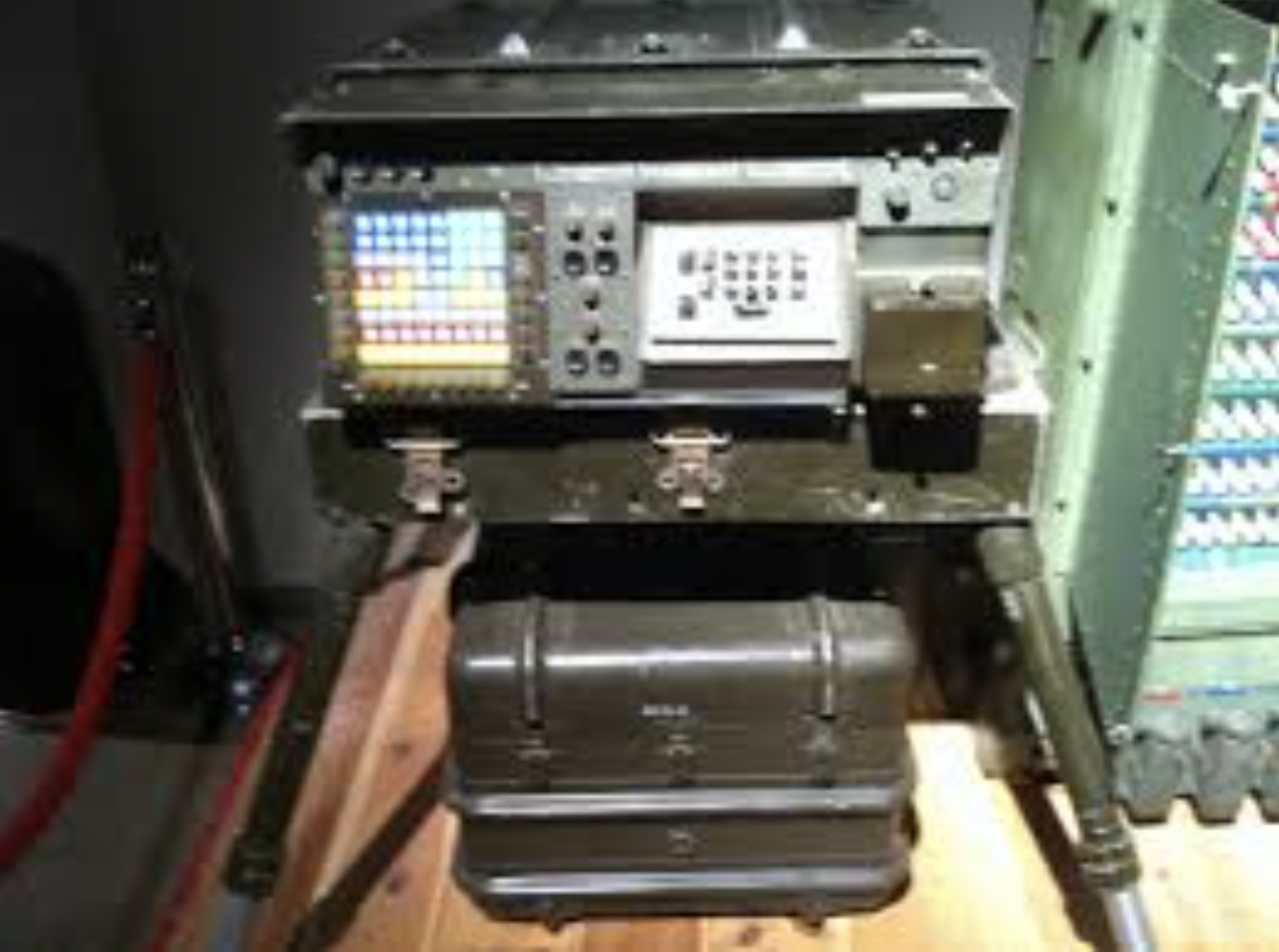
My next encounter with computing technology was in 1970, at Fort Carson, Co., during my first Field Artillery assignment. Our 8-inch self-propelled howitzer unit was involved in field testing “FADAC” (Field Artillery Digital Automatic Computer). Classmate cannoneers reading this may also have encountered it. FADAC was a metal, olive drab box, containing a specialized computer, with a built-in keyboard and small screen. Its’ purpose was to calculate artillery fire direction values such as azimuth, charge, elevation, etc., based on feedback from the Forward Observer. In our tests we ran FADAC in parallel with our manual calculations. I recall that in just about every case the manual calculations team completed and had new fire direction values ready well ahead of the FADAC team. In those early days of computing technology capability and speed, I guess FADAC was not ready for prime time.

FADAC

In 1974, at the end of my service obligation, I decided to change direction from an Army career and join the civilian world. Pondering “what next?”, I thought back to that “CADETRAN” course and decided to begin work toward an MS Computer Science degree at Virginia Tech. This was at a time when computing technology was still quite primitive. There weren’t any PC’s, the internet was years away, and no one had a cell phone. Most computers were behemoths that filled large room(s). Students still had to use punch cards to read programs into the computer. Remember those?

Degree completion took me into my corporate career in information technology. After a few years at Shell Oil, I moved on to Coca-Cola, where I spent the majority of my career. After 10 years at Coca-Cola, that brings us up to 1989 and that newsletter article. So, what did I predict in 1989 for the state of computing technology in year 2000?

  1. A graphic user interface (Windows, MAC) becomes the universal PC standard (at the time there were numerous PC’s still using a DOS interface).
  2. Standalone PC’s (which was mostly the case then) become fully networked.
  3. Fingerprint scanning becomes the PC identity and logon standard.
  4. Voice commands become the standard for PC control.
  5. Email use explodes and becomes ubiquitous (email was very limited in 1989 and mostly on internal company mainframes).
  6. Video files will be watchable on a PC and sent to others via email.
  7. The rolodex becomes obsolete, along with significant reduction in paper filing.
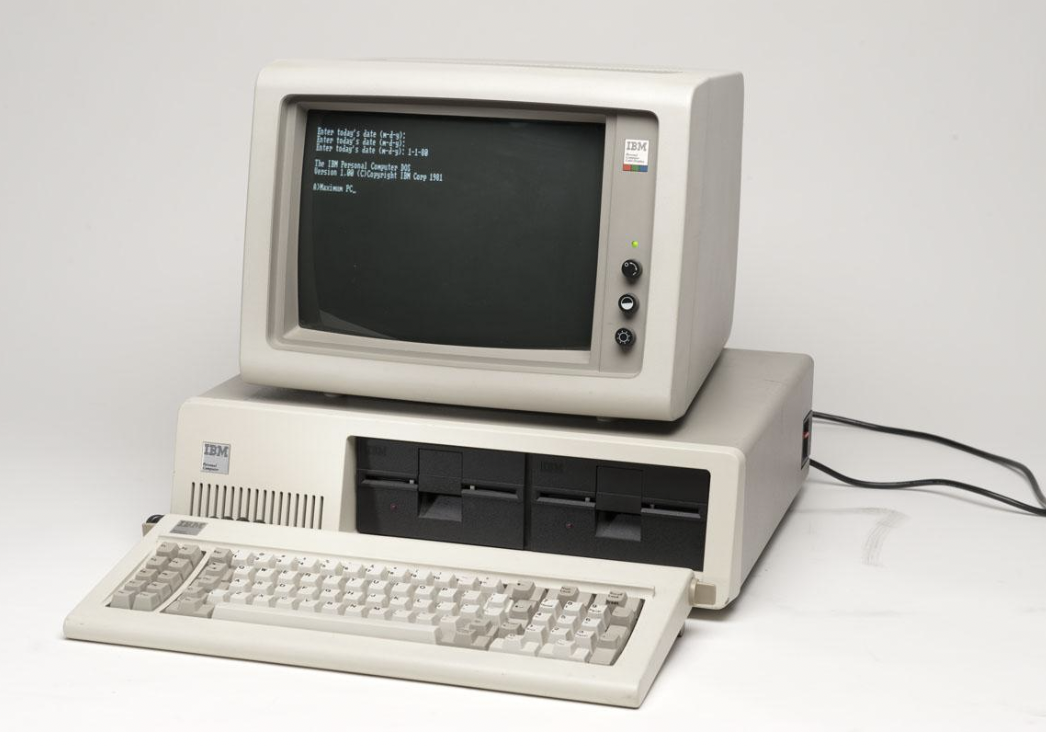
What do old computers look like
PC 1981


How’d I do? Blew #’s 3 & 4 but did reasonably well on the rest. However, even those two were still correct in one sense. They occurred a decade or so later than 2000 and for a different device – the cell phone. Both of those capabilities are now in use on cell phones, but have never become commonplace on PC’s.

Military iPhone
IPhone

There are numerous other key computing technology achievements in the last 30 years that I would not have even conceived of in 1989.

A few examples:

  • The Internet
  • Cell phones as computers, cameras, GPS units
  • The degree of advancement in AI sophistication
  • Google, Facebook, Instagram, Twitter, YouTube, Amazon, Map routing and a myriad of other useful applications
  • Flat monitors
  • Thumb drives
  • Broadband everywhere

Now, we’re in the 4th quarter of 2019, so, what do I predict for 2030 and beyond? Nope, not going there! Let me share 3 historical predictions by noted experts that were spectacularly wrong:

  • “There is no reason for any individual to have a computer in his home” – Ken Olson (Founder, Digital Equipment Corporation) – 1977
  • “I predict the Internet will soon go spectacularly supernova and in 1996 catastrophically collapse” – Robert Metcalf (Inventor of Ethernet) – 1995
  • “There is no chance that the IPhone is going to get any significant market share. No chance.” – Steve Ballmer (Former Microsoft CEO) – 2007

If the CEO of the world’s premier software company can botch a prediction that badly, I think I’ll just rest on the partial success of my 1989 predictions. Plus, I always keep in mind Yogi Berra’s wisdom, when he once said: “Predictions are hard, especially when they’re about the future”.

Written by Suzanne Rice · Categorized: By Pat Porter

Nov 10 2019

Gary Steele, Tight End – 2008

On 12 October 1968, a Saturday, Army hosted Cal-Berkeley at West Point.  Rain and cold had cancelled the regular Saturday morning full-dress parade on the Plain.  The weather was not what the favored Cal team (ranked 16th) was accustomed to.

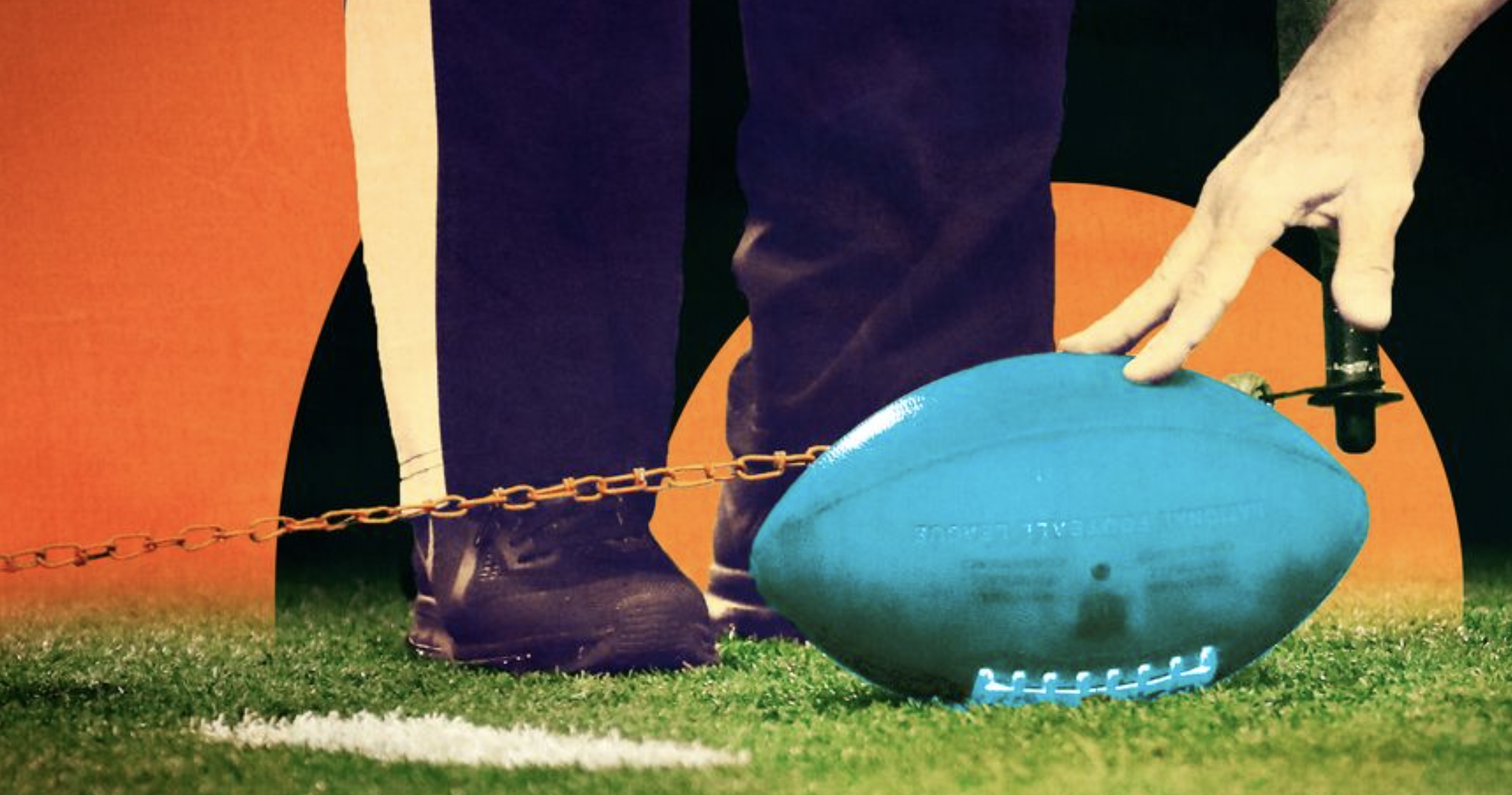
For some reason that I’ve forgotten, I was invited to help man the chain gang at Michie Stadium1

Move the chains football
Work of a football “chain gang”

I had never done that before, so all my senses went into high gear.  “Don’t screw this up!” Seeing the game up close is quite different from standing in row 35.  You get an intimate sense for how tremendously kinetic the Division 1 game is, and how phenomenally athletic the best players are.


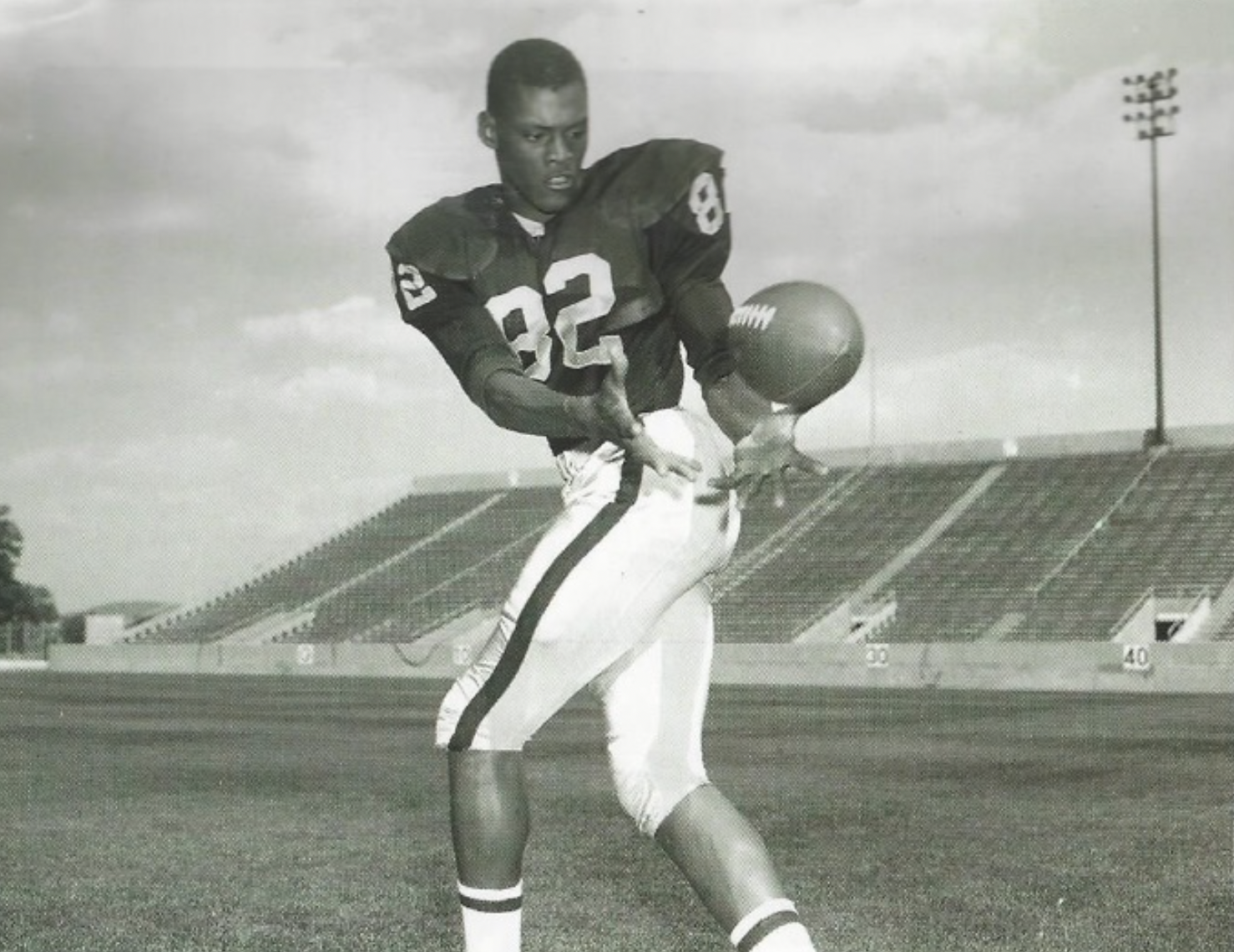
The foul weather and good defense on both sides kept it a low-scoring game.  Somewhere in the third quarter, Army had the ball and was moving toward the Cal goal line, at the south end of Michie.  I was holding my first down pole on the east side of the field, around the Cal 30, when the ball snapped and our big tight end Gary Steele exploded off the line, heading straight for me.  He was flying, a lot faster than he looked from the stands, and his defender matched him stride for stride.

As the play developed, Steve Lindell 2 threw a pass toward Gary.  From my unique perspective, it was obvious that the pass was long and too high.  Gary couldn’t possibly reach it. It would go incomplete.  Too bad.

Gary Army
Gary (82) in action on October 12, 1968


Wrong!  Gary kept on at full tilt, and at the uniquely perfect instant, jumped what looked like ten feet off the ground, a good two feet over his defender.  He hauled in that pass and got two feet in just before momentum took him out of bounds, a couple feet from me. Wow – Unbelievable catch!  First down!  A couple plays later, Army scored our only touchdown, and ultimately upset Cal, 10-7.  Grateful plebes fell out at tables all over the Corps.3

That was our senior year, and Gary’s best.  He caught 27 passes for 496 yards and three touchdowns. Against 4th-ranked Penn State, possibly our toughest opponent that year, he caught eight passes for 156 yards, breaking the Army single-game record set by “Lonely End” Bill Carpenter, Class of ‘60.  Gary was a huge contributor and a big part of our memorable 7 and 3 season, including beating Navy, again.  He was hugely respected, and much loved in our class.

Michie Stadium West Point
Gary at work in Michie Stadium, West Point, NY

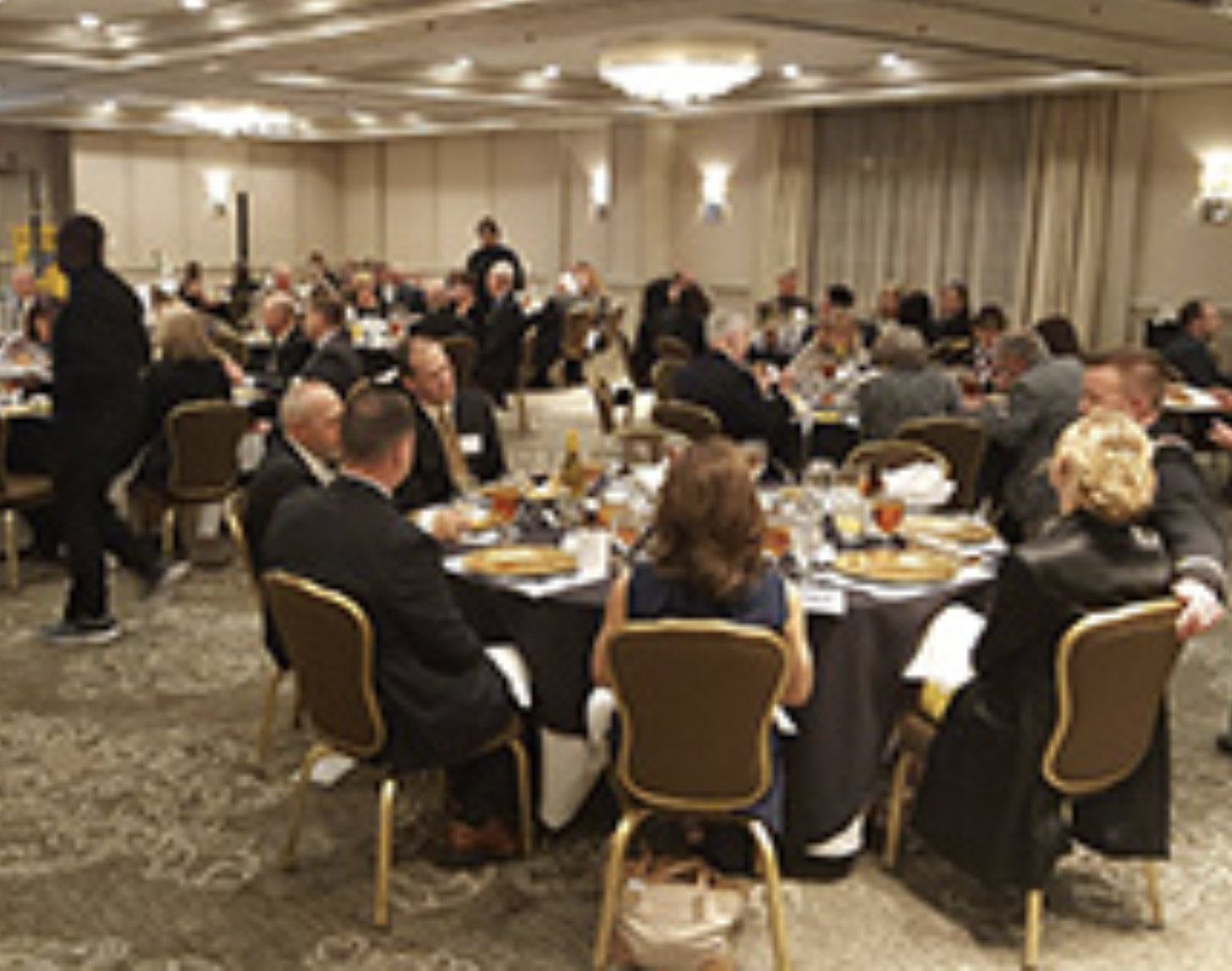
Decades later, at the 2008 Founders Day dinner at Fort Lewis, a tableful of classmates reminisced about how much that football team had meant to us.  Gary’s name came up.


“Great athlete.”  “Great guy.”  People nodded.  One of my classmates said, “You know, Gary was the first African-American ever to play football for Army.”  Everyone emphatically protested.  That couldn’t possibly be true, we argued.  For one thing, we had come to West Point in 1965, and African-American players in Division 1 weren’t exactly a novelty by then.  For another, well, we just all would have known about it, if that had been the case.  Gary was such a seamless part of the team, and of the class, we would surely have known that.

West Point Founders Day Dinner

Someone took out his smart phone and looked it up.  Sure enough, Gary had in fact been Army’s first African-American varsity football letter- man.  And even as well-known as he was in our class, most of us didn’t even know it decades later.  We were stunned. But that’s exactly what kind of classmate Gary was, and what kind of man he became.


Gary Steel Army Team
Gary Steele, Army Football


Footnotes:

  1. Michie Stadium (MIKE-ey) is West Point’s football stadium, named for Dennis Michie, USMA 1893, who played football at West Point and was Army’s first football coach. He was killed in the Spanish American War in Cuba in 1898, aged 28.
  2. Steve Lindell, USMA ’69, was Army’s starting quarterback.
  3. Until the mid-1970s, plebes were required to eat their meals sitting at an exaggerated position of attention – “bracing” – and in silence. For special occasions, the plebe class could be temporarily excused from bracing at meals, which was known as “falling out”.  Winning an important football game would often get the plebes a “fallout” for the week following the game.

Written by Suzanne Rice · Categorized: By Jim Russell

Oct 24 2019

Two Tales of a City, 2015 – Part 2

Fast forward to 2015.  Not only were Sally and I looking forward to a nostalgic trip back to Germany and a visit with friends in Augsburg and Ansbach, but we also had the pleasure of sharing this journey with our sixteen-year-old grandson Gavin.  Forty-two years from our first visit, we landed in Berlin on December 7, excited to see how the city had changed.  We could never have imagined how great that change would be.

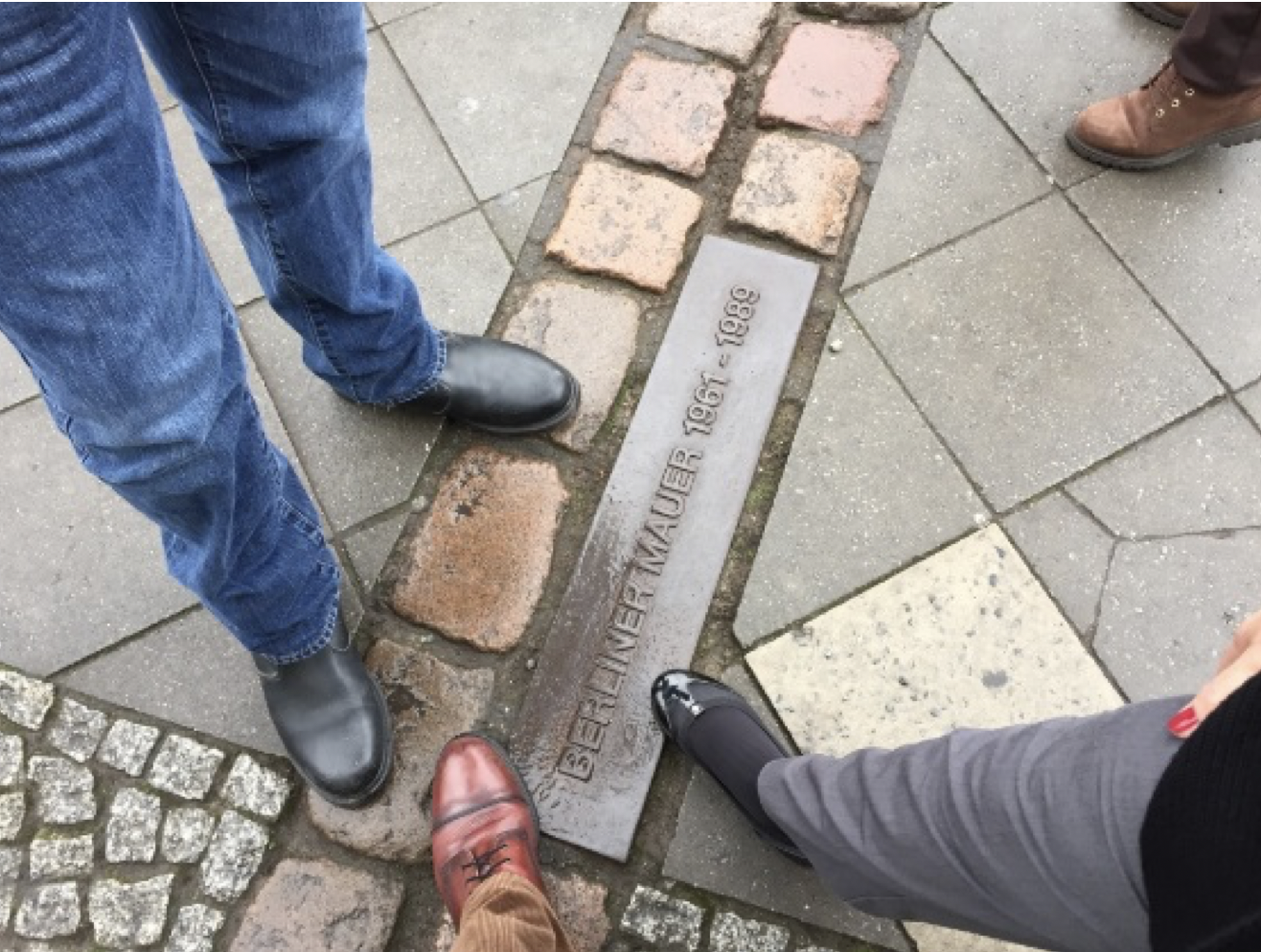
Our new Marriott hotel was located near Potsdamer Platz, a section of the city that was once behind the Wall in the former East Berlin.  As we walked about the area we were stuck by the vibrancy, prosperity, new development, and excitement of locals and visitors.  Busy stores, restaurants, and businesses abounded.  As we crisscrossed the city the brick trace of the Wall, laid out in brass, could be seen meandering along the pavements and streets.  Except for chunks here and there the Wall was gone but its history not forgotten. 

Brick “trace” of the Wall Dec 2015

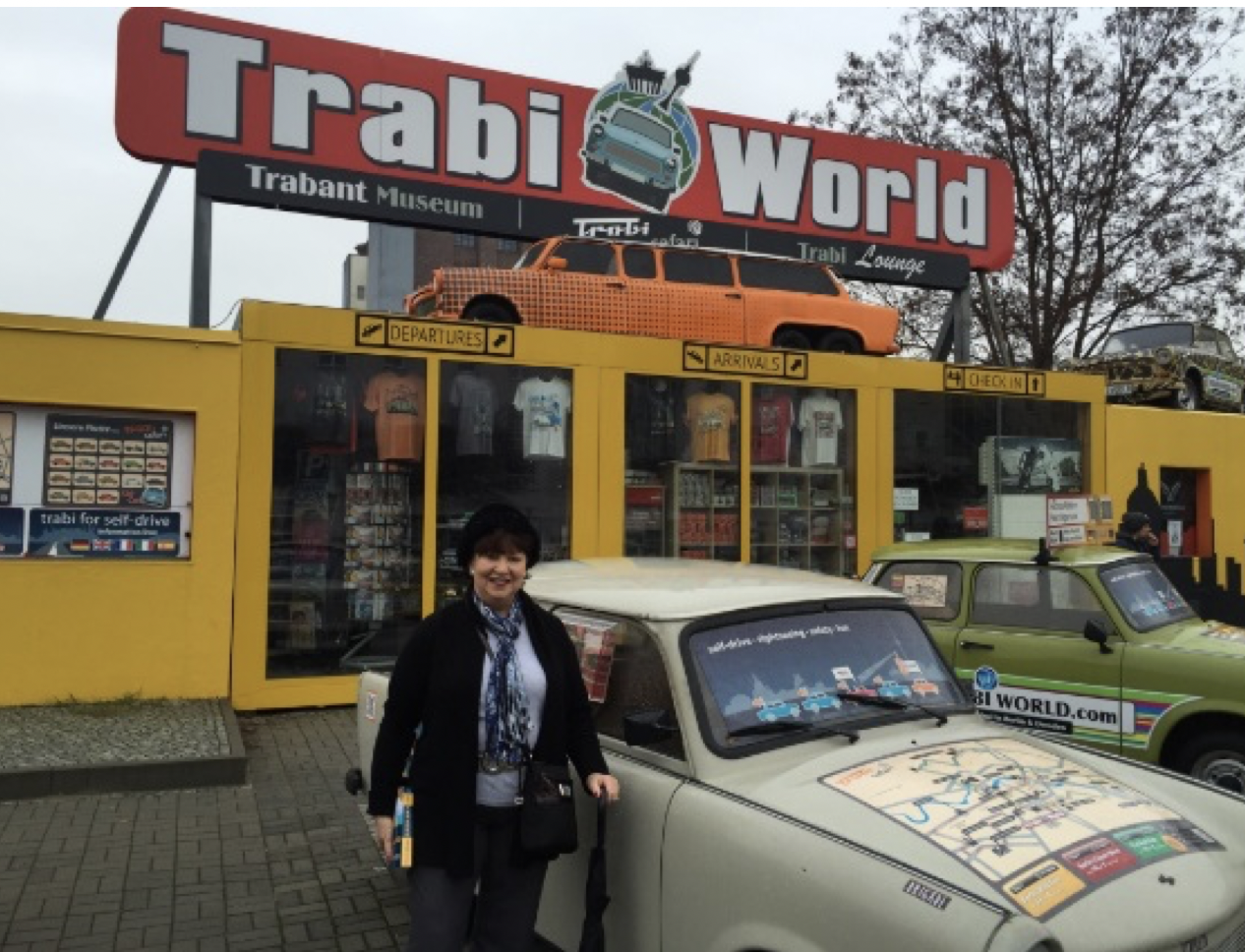
Checkpoint Charlie now existed only as a tourist stop, the guard house remaining but actors in quasi military dress now playing the crossing guards.  Museums to recall the Nazi era, the Holocaust, Cold War, East German gadgets and lifestyle were all available to the public to visit and to remember, with sobering clarity and sometimes with humor.  We’ll never forget walking past Trabi World Tours. 

Sally by a Trabant tourist rental Dec 2015

The old Trabant had made a comeback!  An enterprising and apparently successful Berliner provided rentals for tourists.  Who could resist travelling the city and experiencing a ride in this unforgettable “classic”!?  It was another great example of entrepreneurial capitalism popping up in unexpected places.

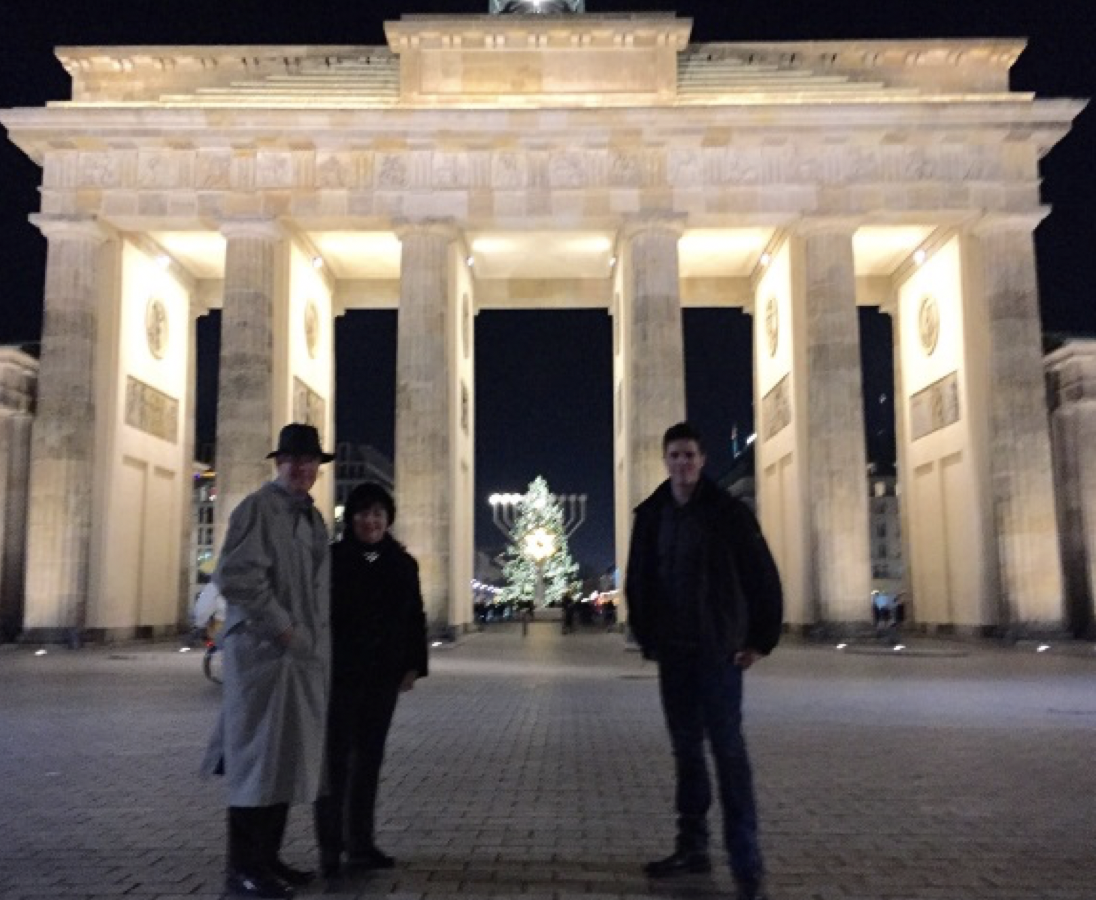
Perhaps our most enduring memory came at the start of our trip.  When we landed in Berlin it was late afternoon, and as our taxi sped into the city the early December night had fallen.  The lights along the streets showed a city alive with activity and the Christmas season beginning.  Straight ahead we could see in the distance the Brandenburg Gate brightly lit.  Through its arches were clearly visible an enormous Christmas tree, a large Menorah and Star of David.  All three were brightly shining and spoke in such a powerful way of reconciliation in a city once torn by hatred and oppression.  We will always be grateful for the blessing of this gracious memory, a beautiful benediction to our Berlin experiences.  Indeed, “… it was the best of times.” 

At the Brandenburg Gate 2015
Inside the Brandenburg Gate in former East Berlin


P.S. From co-authors, Eric and Sally: for excellent reference, we recommend the book

The Collapse, The Accidental Opening of the Berlin Wall, by Mary Elise Sarotte.

Written by Suzanne Rice · Categorized: By Eric Robyn, By Sally Robyn

  • « Go to Previous Page
  • Page 1
  • Interim pages omitted …
  • Page 34
  • Page 35
  • Page 36
  • Page 37
  • Page 38
  • Interim pages omitted …
  • Page 49
  • Go to Next Page »

Footer

Historians and other inquiries.

Submit a Form

Join our community.
Subscribe to Our Bulletin

Copyright © 2026 · Site by RK Studios