• Skip to main content
  • Skip to footer

The Days Forward

West Point Class of 1969

  • Starting Out
    • Reception Day
    • Making the Cut
    • Becoming a Cadet
    • Where Did They Go?
  • Browse the Stories
    • Authors
    • Map
    • Search
    • Archive
  • Contact

Suzanne Rice

Mar 09 2022

Country – A View from Abroad – 1975

      The University of Bonn had the reputation, among West German universities in the mid-1970’s, of being relatively conservative and orderly.  However, when I was privileged to study there beginning in the fall of 1974, I was astonished at the prevalence and virulence of Marxist thought among the students.  Echos of the 1968 student revolution in western Europe still reverberated throughout the university, and anti-capitalist rhetoric was common and went largely unopposed in student discussions and throughout the student social scene.
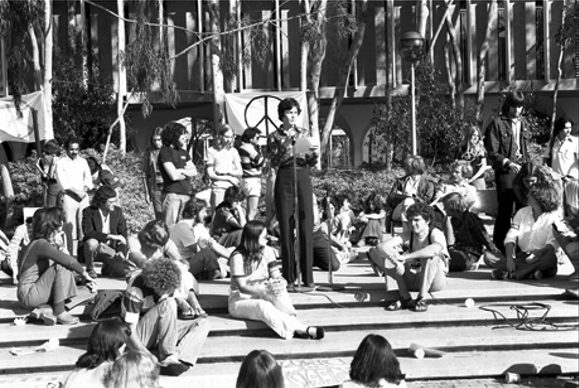
German Student Demonstrations in 1968 (Field Journal)

    However, most of the lectures and seminars that I attended, in history and political science, were led by professors who presented balanced, responsible scholarship.  It was not unusual for activist students to “take over” a lecture just before a class would begin, occupying the front of the classroom and insisting on the necessity and urgency of social solidarity and action to oppose capitalist propaganda.  When this happened, the typical professor would walk in, move to the front of the classroom, wait a couple of minutes with modesty and dignified patience, and then interrupt the student and suggest that it was perhaps time for him to have a turn and present his lesson. Activist students sometimes tried to carry on, but students in the classroom usually showed a preference to have the professor do the lecturing.  In spite of the passion with which the activist students asserted themselves, such confrontations–at least the ones I witnessed–were peaceful, lacking even a suggestion of physical intimidation, and spectator students in the classroom were normally dispassionate regardless of their social/political leanings.

     Only once did I see a professor get excited and angry when this kind of thing happened, but that one exception was memorable.  It was a lecture in a regular political science course by Professor Krazewski, a visiting professor from Poland.  At the time, Poland was part of the Soviet empire, behind the Iron Curtain.

Poland Behind the Iron Curtain (Weebly.com)

     Prof. Krazewski had arrived at the University of Bonn in the fall of 1974. The fact that the Polish regime (and the Soviet Union) had permitted his year-long residence and teaching in West Germany suggested to me that he was a reliable Communist, with a thoroughly Marxist/Leninist interpretation of history and international relations.  That’s why I wanted to hear his lectures.  (Know your enemy.)

     At the end of April and on 1 May 1975, the last of the U.S. presence in Vietnam ended in the ignominious rout that we of the Class of 1969 remember so vividly. At the University of Bonn, students were gleeful–the underdog communist North Vietnamese had prevailed over the neocolonial imperialist United States of America. Gathering for Prof. Krazewski’s lecture that day (my notes taken at the time show it was 29 April 1975), the students were raucous, celebrating as the class was about to begin, and several students had occupied the front of the classroom and wanted the professor to celebrate with them and change his topic to the war in Vietnam and the defeat of the United States.

Typical Classroom at the University of Bonn (Volker Lannert / Universität Bonn)

     Prof. Krazewski was not amused. He became angry and berated the students, accusing them of immature foolishness and of failing to understand what that war had meant for the Communist movement. He said that tremendous resources had flowed from Poland and the other satellite states to fight the United States in Vietnam, and the economic impact had been devastating; if it had not been for that war, the Soviet Union would have beat the United States to the Moon.

    Angry overstatement? A narrow and prejudiced view from a member of the Polish “nomenklatura” who had been denied the standard of living so evident in the West?  I don’t know.  But I have never forgotten his reaction to the students, who were so sure that they were witnessing a huge milestone in the worldwide struggle for social justice. Prof. Krazewski helped them toward an understanding: it’s not so simple.  The economic effect of the war on the Soviet empire was enormous and stressful. And I believe it’s not wrong to say that it was the social and economic pressure of our country on the Soviet empire that won the Cold War.

    While attending the university, I tried to be modest and blend in as just a student, but I made no secret of the fact that I was an active-duty Captain in the U.S. Army.  As a class was about to start on 1 May, after news reached the world of the departure of the last American helicopters, one of the student activists addressed me.  He was not trying to denigrate me, but his tone was, “America deserved this outcome, and we told you so.”  I responded that four U.S. administrations of both political parties, had tried to defend a semblance of South Vietnamese freedom in the face of North Vietnam’s military aggression, so it wasn’t just one cabal of American capitalists manipulating the public and pursuing profits.  He hadn’t thought of it that way, and it quieted him some.

    Our country is certainly not always “right,” as each of us has seen in our lifetimes of service to her. Still, there is a lot of good that results from the high ideals that the United States stands for and that we accepted upon graduation and have worked to further. And perhaps even in some of our worst failures, the ideals we try to uphold prevail and make our country better.
Written by Suzanne Rice · Categorized: By Phil Clark

Feb 11 2022

Honor – Encounter with the Honor Code – 2021

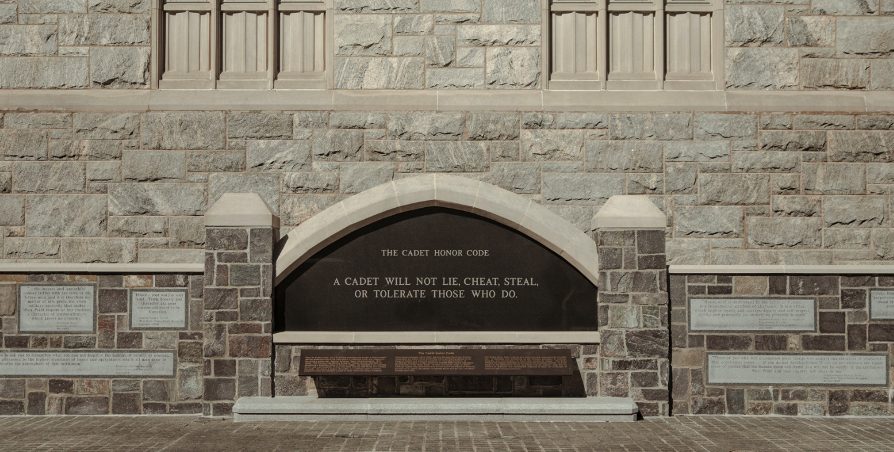
     During the Coronavirus pandemic, classmates from Cadet Company E4 kept in touch with monthly Zoom meetings.  During one meeting there was a discussion of the Honor Code: “A cadet will not lie, cheat, steal, or tolerate those who do.”  The discussion went on for some time.  It reminded me of my own experience with the Code.  I did not bring up my “incident” because the meeting was already running long, and we didn’t have a paid Zoom account.

     The discussion jogged my memory, and I emailed the two guys I roomed with at the time to confirm my memory.  Here is part of the message:

“One evening early in Plebe (Freshman) year, we were all in the room studying when one of my two Plebe roommates walked by and noticed I was studying the wrong chapter (obviously I was already goat* material). I switched to the correct chapter.  This led to a discussion among the three of us something like: “Wait a minute, is this unauthorized assistance, i.e., cheating?”  Fearing an early end to my cadet career, I turned myself in to the company Honor Rep (each Cadet company had an Honor Representative). Don’t remember who it was, but he was napping on the top bunk when I reported to him.  I explained the situation, and he responded to the effect that so long as no one helped me solve problems or complete the assignment, there was no cheating.

     The (thankfully) brief concern about being thrown out for an Honor violation has stuck with me.  That was my only brush with the Honor Code, and I managed to maintain my position in the bottom 6% of the class.  Or the top 94%, to put a more positive spin on it.

     I still have the 1964 -1965 USMA catalogue which I received in the mail as I was considering attending West Point.  When I thought about writing this story, I referred to the catalog to confirm that we were actually exposed to the Honor Code long before R-Day (Reception Day, July 1, 1965, the day we entered West Point as the Class of 1969).

Bernie’s West Point Catalogue from 1964-65

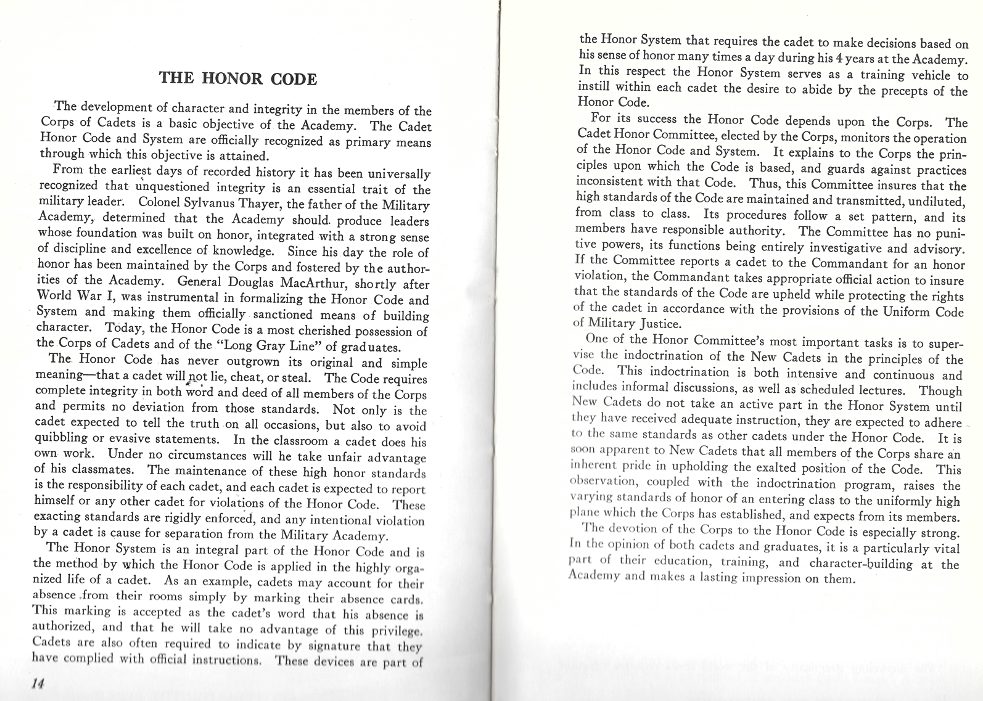
In the 192-page catalog, there was a 2-page summary of the Honor Code — on pages 14 & 15 — before Education and Training that was discussed on page 16!  

Pages Introducing the Honor Code to the Class of 1965

     Our Class was exposed to the Honor Code early and often.  The Honor Code was addressed in detail in our Bugle Notes (an information book, most of which was to be memorized by Plebes and recited on demand during Plebe year.)

          Bugle Notes to be Memorized by the Class of ‘65

I’m pretty sure we had formal and informal Honor Code presentations or discussions early in Beast Barracks.  It was not something we took lightly.  Hence, turning myself in when in doubt of a violation.

      Finally, I should point out that the Honor Code was not only a cadet responsibility.  It’s a lifelong commitment to living honorably.

* Goat: the last person in the class academically.  Collectively, Goats are the bottom half of the class.

Written by Suzanne Rice · Categorized: By Bernie Tatro

Feb 11 2022

Duty – In Gratitude for Chaplains – 2001

     Over the course of my life as an “army brat,” a soldier and a retiree I have been well served by military chaplains representing a wide array of backgrounds, races, genders and creeds.  Almost every one of them was able to provide meaningful pastoral care to the soldier or family member in need of spiritual direction regardless of that person’s faith, be it strong or non-existent.  Those with whom I served were also astute observers and thoughtful advisors concerning the command climate, morale of the troops, and other sensitive issues.

     Indeed, our chaplains do so much more! In Cold War Europe, for example, our chaplains served both congregations in our communities and our troops on maneuvers or in “density” at major training areas like Grafenwoehr. I remember well, and with BOTL-pride, listening to our own Chaplain Geoff Moran over AFN radio as he delivered the spiritual message of the day for all of USAREUR. https://thedaysforward.com/word-in-the-world/  In Vietnam, morale went up when a chaplain flew into the firebase or the jungle. Regardless of the day of the week, that day became Sunday! Later, we all prayed along with Chaplain Ray Dupere as he led us on a memorial tour, cemetery to cemetery across America, to solemnly acknowledge the ultimate sacrifice made by our classmates fifty years earlier.  https://thedaysforward.com/semi-final-resting-place/ https://thedaysforward.com/semi-final-resting-place-2/

     Several chaplains have become special members of my family; their witness encouraged my daughter Mary, USMA ’02, to follow those footsteps.  She serves as a chaplain in the Colorado Army National Guard.

A Shephard in Combat Boots

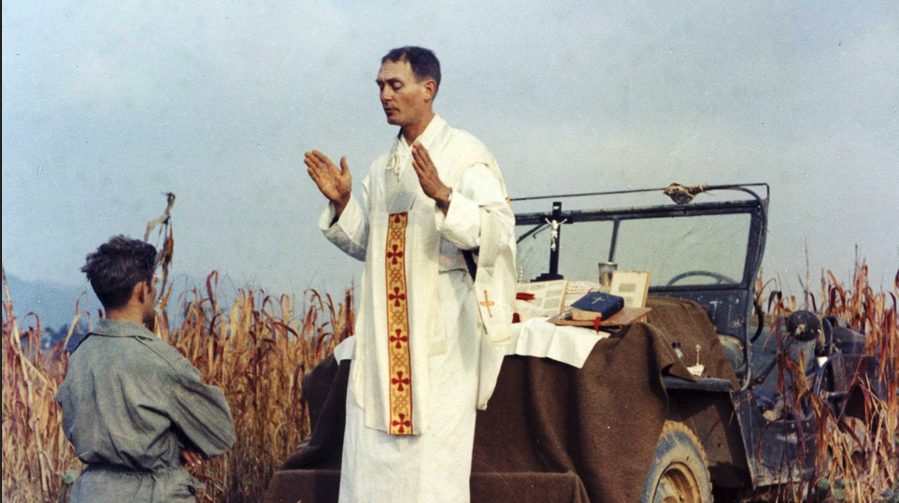
     Late in my career I had the good fortune to “meet” another very special chaplain.  I was privileged to command the 24th ID and Fort Riley, Kansas in 2000-2001 at which time the post was a designated installation for commemorations of the 50th anniversary of the Korean Conflict.  We proudly hosted and honored many veterans with parades, reunions, and the like.  In the spring of 2001, the Archdiocese of Wichita contacted us to request support for the dedication of a statue of a deceased Korean War veteran, a Catholic priest named Emil Kapaun.  When I asked who he was, I was handed a book entitled A Shepherd in Combat Boots.

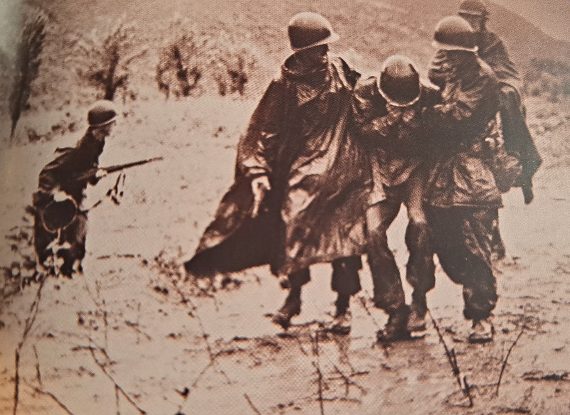
     Emil Kapaun was born 20 April 1916 and raised in the small farming community of Pilsen, Kansas inhabited mainly by Czech immigrants.  He was ordained in 1940 and served in the diocese until becoming an army chaplain in 1944.  He served in Burma during World War II and deployed with the 1st Cavalry Division to the Korean Conflict in 1950.  His courage was legendary in the 1st Cav.  Father Kapaun was always on the front lines conducting services, encouraging the weary and frightened, and sharing their experiences.  He was the guy who dragged the wounded to safety during a firefight.

Father Kapaun (right) Helping a Wounded Soldier Off the Battlefield in Korea (Acme Photo)

He was the guy who would drop into a soldier’s foxhole during a mortar attack to offer the startled fellow an apple and to check morale. For his extraordinary courage in near constant contact, he was awarded Distinguished Service Cross. 

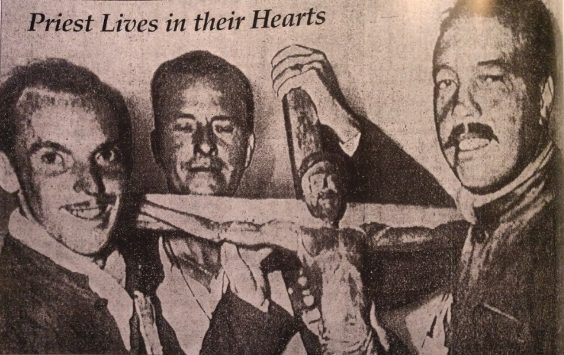
     On 1 November 1950 as allied forces approached the Yalu River, Chinese Communist forces entered the battle.  His battalion was surprised by their attack and was quickly overwhelmed at Unsan. He, of course, was with the wounded, refusing to leave them behind, and was captured on 2 November.  Within minutes he saved a wounded soldier, Sergeant Herb Miller, from being executed. He then carried Miller for the first 10 miles of the long march to the POW camp.  For the next seven months, he was the ultimate servant-leader, spiritually and in every other way, under the harshest conditions.  He went far beyond the call of duty:  he was the “good thief” who was able to deliver extra food; he washed their wounds; he performed myriad other life-sustaining efforts, prayed with them and conducted “forbidden” religious services.  Against all odds, he bolstered their morale and gave them hope, buffeting the re-education classes and reminding them that they were valued American soldiers who could survive and return home.  The Communists both hated and feared him.  Their mistreatment of him eventually caused his death in May 1951.  Even those who became prisoners after his death were inspired by what he had accomplished.  One of these, Captain Gerald Fink, USMC, a man of Jewish faith, carved a nearly four-foot-tall crucifix with a barbed-wire crown to honor Kapaun whom he had never seen. Those who had known Kapaun in the POW camp were amazed at the resemblance of the Christ figure to the good padre.  The crucifix was the “banner” under which the POWs paraded out of camp two years later; it remains an inspirational reminder in the entrance hall of Wichita’s Kapaun High School today!  

The Crucifix in the Kansas

Testimony of his courageous leadership by surviving POWs, especially 1LT Mike Dowe, USMA ’50, led to his eventual award of the Congressional Medal of Honor in 2009.  Their testimony of his sacrificial gift of himself to his fellow POWs in imitation of Christ led Pope John Paul II in 1993 to declare him a Servant of God, the Catholic Church’s first formal step toward sainthood.

A Memorial for the Troops

     I was moved and very inspired by his story.  On 3 June 2001 I went to Pilsen with our mounted color guard, our chaplains, and an honor guard and participated in the touching dedication of the statute.

Statue of Father Kapaun Dedicated in Pilsen, KS

Upon return to Ft. Riley, I asked my staff if we could re-name the Custer Hill Chapel in the troop area after Chaplain Kapaun.  They dutifully forwarded a request to the Pentagon.  We promptly received a response: DISAPPROVED:  cannot name a chapel after a person.  In frustration, I asked, “What can we name?”  “A street.” came the reply.  “What street runs into the parking lot of the chapel?” I asked.  When I learned that it was a one-block dead-end street, we re-named it Kapaun Street and our re-submitted request for the Kapaun Street Chapel was approved.  In November 2001, fifty years after his death in the POW camp, the Kapaun family joined the Ft. Riley command for a ceremonial rededication of the chapel as the Chaplain (CPT) Emil Kapaun Chapel and across the parking lot, the newly named Kapaun Family Readiness Center.  Soldiers and families would now enjoy facilities named for this soldier-chaplain-hero, a fitting conclusion to our 50th Anniversary of the Korean Conflict Commemoration events at Fort Riley.

A Moving Funeral for a Future Saint

     Now…the rest of the story.  Father Kapaun’s remains were returned to the US Army in 1953 but remained unidentified.  He was interred in a grave marked “Unknown but to God” in the Punchbowl Military Cemetery in Hawaii.  Finally, in early in 2021, due to advances in the science and technologies of DNA, his remains were positively identified.  He would finally be returning to Kansas for a hero’s welcome and proper burial. Decades of prayers had been answered!

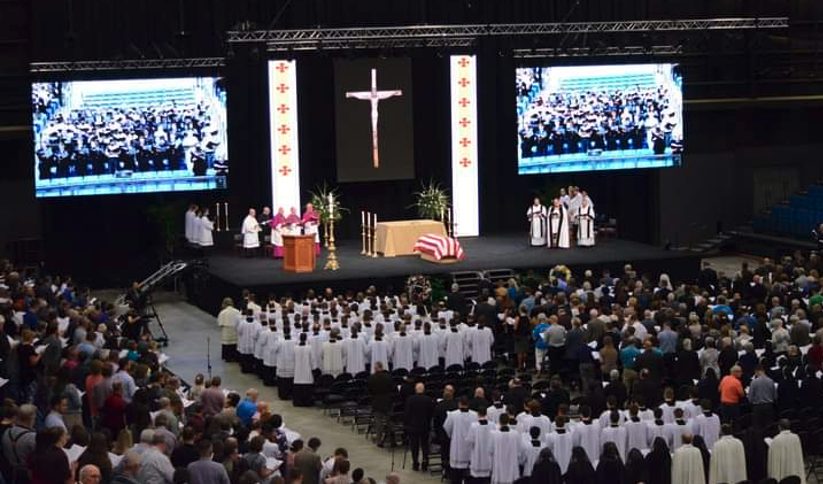
     On 29 September 2021, 70 years after his death, the “world” saw on television what 6000 witnessed in person in Wichita, Kansas, the Mass of Christian Burial for Father Emil Kapaun.  The solemn ceremony was celebrated by Archbishop of the Diocese of Wichita and concelebrated by five other bishops, assisted by myriad priests, deacons, speakers, cantors, and a mixed choir from parishes, local Catholic high schools and the military academies. 

Mass of Christian Burial for Chaplain Emil Kapaun

Soldiers, young and old, from near and far, including the command teams from Fort Riley and from the 1st Cavalry Division, attended to rejoice over his return, to honor and to celebrate his life of amazing and heroic service.  After the Mass, Father Kapaun received full military honors and was entombed in a special vault in the Cathedral of the Immaculate Conception in Wichita. Several of his fellow POWs, including Sergeant Herb Miller, attended the funeral.  My wife Joan and I along with classmate Joe McCarville and his wife Diane were also privileged to attend.

     For his brothers in the clergy, his family and the people of Pilsen, the surviving POWs, today’s soldiers, kids from Father Kapaun and Bishop Carroll High Schools in Wichita, and the entire community, these events were ones of joy, hope, and inspiration.

Getting to Know this Man of Heroic Virtue

     Father Kapaun’s extraordinary performance, clearly above and beyond the call of duty, exemplified the motto of the Chaplain Corps, Pro Deo et Patria, For God and Country. Since “meeting” him in 2001, Father Kapaun has become my spiritual inspiration, my go-to-hero, a patron saint of sorts: my model of what it means for a Christian to “pick up one’s cross and follow Christ!”


Warrant Officer Felix J. McCool and Lieutenant Ralph Nardella display a hand-carved crucifix made by a Jewish Marine, Captain Gerald Fink, in memory of the Catholic priest/chaplain, Captain Emil Kapaun, a fellow POW.

     If you are interested in an authentic story about heroic virtue read A Shepherd in Combat Boots or The Miracle of Father Kapaun.  Search YouTube for the many videos about Father Emil Kapaun.  You will not be disappointed.

Written by Suzanne Rice · Categorized: By Bob St Onge

Feb 11 2022

What West Point Means to Me

When I began to think about “What West Point Means to Me”, for some strange reason I had a flashback of that songs by the Animals, “We Gotta Get Out of This Place.” I know that sounds terrible, but I could also see everyone rushing to the dance floor and we still dance to it at reunions. Was it really that bad or were we in such a hurry to get on with our lives? Maybe a little bit of both.

    For the guys, it may have been the restrictions, especially for the times when many former high school classmates were having an entirely different college experience. For most of the ladies, completing our degrees, starting a career and maybe a wedding, were what we saw in the not-too-distant future. 

     Our first assignment was the Armor Basic Course at Fort Knox, KY, distinctly different from West Point. I was definitely out of my element, a newlywed, living far from home, learning what was expected of an army wife. I read Mrs.Lieutenant from cover to cover, and it didn’t make me feel any better. Maybe, West Point wasn’t that bad after all and maybe because it was familiar. Everyone from Cadet Company A-2 was dispersed to their basic courses or grad school. I did enjoy meeting new people but missed those faces that I became so attached to and treasured. Most of the wives were just as uncertain about Army life as I was, so there was a common bond we all tried to appreciate. Hats and gloves were the order of the day and we looked like those old Avon Lady commercials. It was 1969-70, for goodness sake. No one wore hats and gloves. Bell-bottom pants, fringed jackets and love beads were what civilians wore. Somehow, we managed to pull it off for those important receptions we were expected to attend.  We donned our post-wedding going-away outfits and a wretched hat that didn’t match anything. 

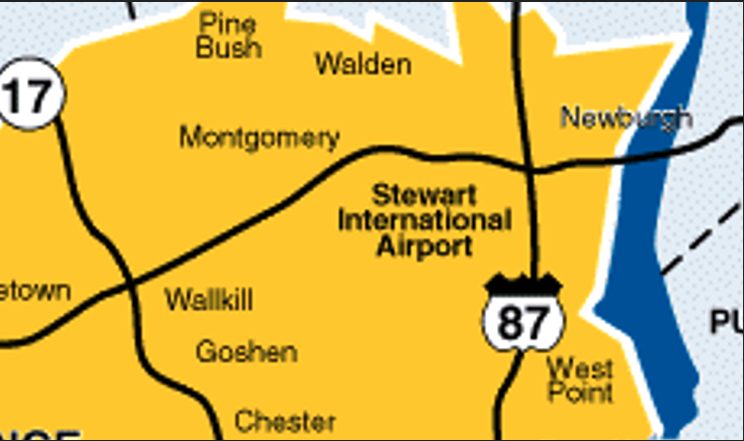
     In late 1971, we returned from Germany with infant twins and Denny left for Vietnam. I chose to live at a former air force base that was now called Stewart Airport. Much of the military housing left behind was set aside for “waiting wives,” my new title apparently, not much better than “dependent.” That little community also included professors and their families who were waiting for quarters* and any other overflow military folks that could not be accommodated immediately at West Point. It turned out to be a good experience. My parents lived nearby, and I was 20 minutes from the gate at West Point. The Army maintained my adequate quarters. At Stewart Airport, we had a small commissary** and PX***, nursery/daycare and a medical clinic headed by a pediatrician which was very convenient. The Military Police would circle the housing area at least once every hour and our long-haired dachshund was often picked up by them for wondering off the tiny lawn. It was always a little disturbing to see a big, tall MP standing at my door with Oscar sitting calmly beside him. I couldn’t always get everyone inside in a timely fashion after a walk – two babies and a twin stroller that refused to collapse easily; maybe, that poor dog was just forgotten in the turmoil. 

     Occasionally, I would go to the larger facilities at West Point and just driving through the post brought back fond memories and even some comfort for a “waiting wife.”

     It seems like so long ago. Those infants are now 50 years old. The unique experience of West Point still pulls us together as a couple, along with the Company A-2 “fraternity,” and all the other classmates and grads we have met along the way. I’m so proud that my husband attended one of the highest-rated colleges in the country leading him to a 20-year military career, but it means so much more.

And finally, full disclosure, I listen to a 60’s station on my car radio and when I hear the first few bars of that song by the Animals, I still get a big smile on face. I can’t help it!

 *term used for residential housing on a military post or base

**Army grocery store

*** post exchange – a small department store

Written by Suzanne Rice · Categorized: By Pat Wance

Jan 24 2022

Fish Killer – 1975

From 1972 till 1975, the First Cavalry Division at Fort Hood was an experimental test bed for the US Army, trying all kinds of innovations.  The division was called TRICAP [Triple Capability] because its first brigade was an armored brigade, the second brigade was the Air Cavalry Combat Brigade, with three different types of aviation units, and the third brigade was an airmobile infantry brigade.  When I took command of Charlie Company, 8th Engineer Battalion [“SkyBeavers”] in 1974, it was organized and equipped as an airmobile combat engineer company which directly supported the third brigade. These airmobile troops are transported to the battlefield by helicopters from their own division unlike airborne troops that jump out of airplanes flown by the USAF.

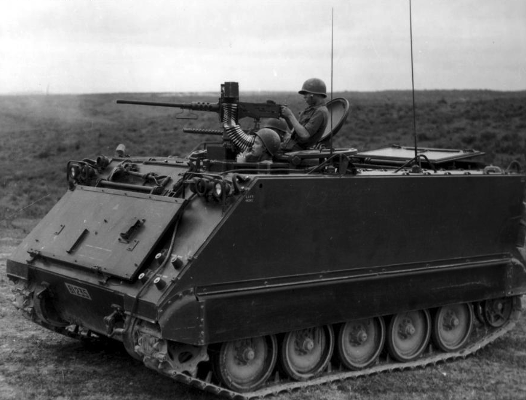
     During 1975 the Army converted the 1st Cav to a conventional armored division, with three brigades of mixed tank and mechanized infantry battalions.  On paper, C/8th Engineers was reconfigured as an armored engineer company, with M-113 armored personnel carriers as squad vehicles for each of the nine combat engineer squads.  In reality, creation and conversion of the division’s airmobile infantry battalions to mechanized infantry took up all the M-113 APCs in the Army’s stateside inventory.

     Eventually, the Army learned that the North Carolina Army National Guard had a cannibalization lot of old M-113s they had junked for new APCs years ago.  So, the NCARNG transferred nine of these old junkers to Charlie Company, Skybeavers.  I was fortunate to have the finest maintenance section in the whole 1st Cav, but even so, it took my guys several weeks to get all those old rags off deadline and operational. 

Old M-113

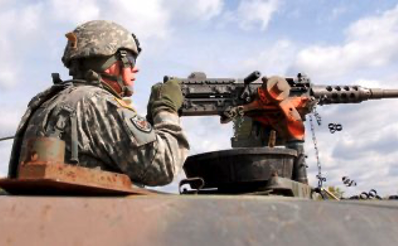
     Next mission was to qualify my tracks and their crews in their new equipment.  First step was taking my engineers to the range and qualifying them on the nine M-2 Cal .50 machineguns that came with their APCs. 

Soldier qualifying on an M-2 Machine Gun (The National Interest)

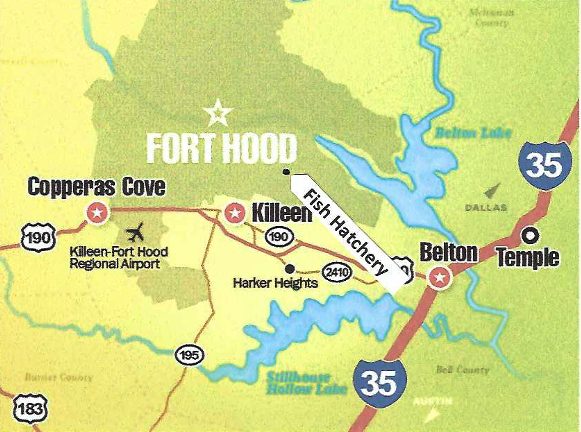
     Finally, we had to demonstrate the amphibious capabilities of the tracks by taking them swimming. Fort Hood has a designated track swimming site located on the banks of Lake Belton, many miles from the cantonment area of main post.  I submitted my training plan for the upcoming week through our S-3 Operations Officer to the battalion CO to swim our tracks Thursday morning. 

     On Thursday morning, as we were forming up in the motor pool to move out, my second platoon leader rushed up to me and said excitedly, “Sir, we don’t have to go all the way to Lake Belton to swim the tracks.  I found a perfect place, and it’s really close to us.” 

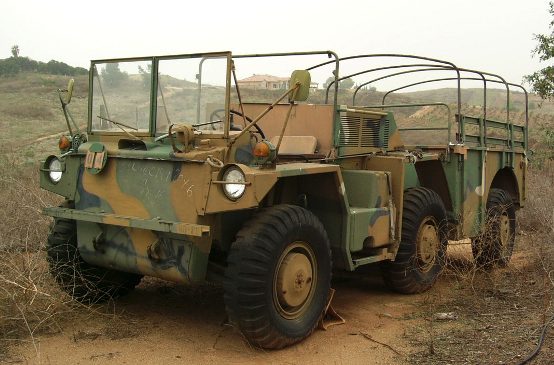
     I made a command decision on the spot, and said, “OK, Rob, show me what you found.”  So, our convoy moved out, with my second platoon leader in his Gama Goat (a six-wheeled semi-amphibious vehicle that my platoon leaders each had) leading my jeep.

Gama Goat (Mark’s Tech Journal)

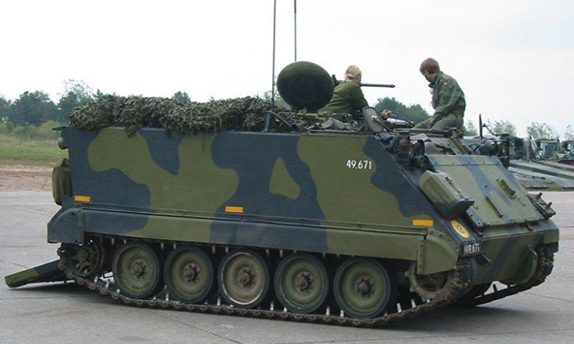
     Behind us came my two other platoon leaders and our nine resurrected APCs. 

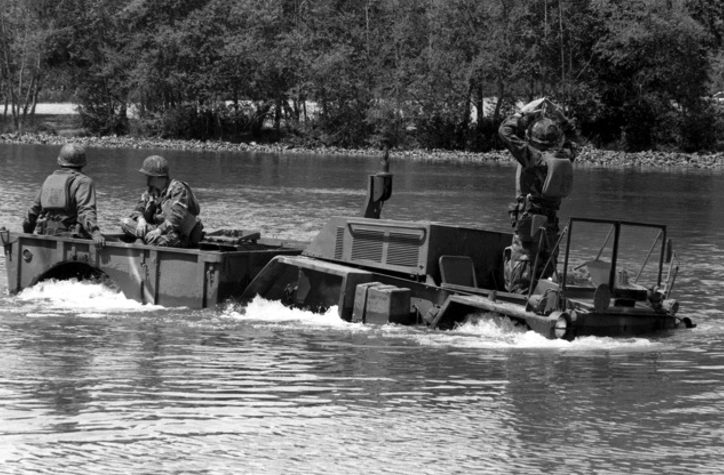
Resurrected M-113 Ready to Swim

Each track had a driver and the squad leader as track commander.

     My lieutenant led us to a beautiful pond about 200 meters in diameter, just a few miles distant from main post, with a really fine ramp for entry and exit.  The most important item to check on APCs before taking them into water is to ensure that the hull drain plugs are installed good and tight.  Many an officer has seen his career dissolve when he discovered that APCs without drain plugs sink to the bottom in about 20 seconds.  I wasn’t going to make that mistake.

     After final drain plug checks, we began swimming the tracks, one at a time, starting with my second platoon.  Gently drive into the water, steer forward about 100 meters using the tracks for propulsion, turn around, and drive back up on land.  Mission accomplished.  Next track.  Everything was going smoothly.

     With just one APC left to swim, I told my first platoon leader, my senior lieutenant, to go ahead and take everyone who had finished swimming back to the motor pool to begin the post-swimming maintenance.  I would bring the last APC in myself as soon as we finished.

     Before he rolled into the water, the last track commander told me, “Sir, my bilge pump ain’t working.”  I told him we were just going in and out, so that wouldn’t be a problem.  So out he went.

     About 75 meters into the pond, his track began to turn left.  Confused, I watched him swim two circles.  Then he stopped, and began to reverse, re-tracing the circles he had just swum.  When I finally signaled him to idle the engine, he hollered to me, “Sir, we threw the left track.  With only the right track working, all I can do is go in circles.”  Meanwhile, with no working bilge pump, the APC was riding lower and lower in the water.  He continued telling the driver to go forward and reverse, hoping that something would enable him to get to shore.  With just my jeep, there was nothing I could do but watch.

     About this time, we heard the” WOP, WOP, WOP” of the division commander’s helicopter landing behind us, and out stepped the two-star general, followed closely by my battalion commander.  Unbeknownst to me, the division staff had forwarded our swimming exercise to the Commanding General as “training highlights.”  They had flown out to Lake Belton looking for our swimming exercise and were quite unhappy not to find us.  Just by chance, the pilot had seen our track in the pond.  Surprise, surprise!!

     In the 30 seconds it took me to describe what was happening in the pond, I could see steam rising from my colonel and the general.  They walked down to the edge of the pond and offered a few inane suggestions on how to get the APC ashore, just in time to watch the M-113 abruptly sink to the bottom.  Fortunately, my track commander and his driver escaped and swam for shore.

     It turns out the pond was the Fish and Wildlife fish hatchery, completely off limits to all military traffic.  When the M-113 sank, about 50 gallons of diesel fuel got released and killed some 30 million baby fish.  My battalion CO was severely embarrassed in front of his Commanding General.  That was not one of my better days as a commander.  That single ‘aw shit’ wiped out several hundred ‘atta-boys.’  But we all survived.

Location of the “Perfect Place” for Swimming the M-113’s

     I had made the command decision to change the swimming location without telling my chain of command.  Everything that could go wrong did go wrong.  I owned full responsibility for everything my company did or failed to do and took my ass-chewing like a gentleman.

     On top of that, the 50 gallons of diesel completely contaminated the entire fish hatchery, and the USDA wound up spending $2.3 million in remediation expenses [in 1975 dollars].  

     Here are the leadership lessons:  

1.  My battalion CO never burned me for that.  He certainly could have.  All he ever said to me was, “I wish you hadn’t done that.”  [I continued in service, getting accidentally promoted two more times after this event.]

2.  The Division CG never burned my Engineer battalion commander, who went on to pick up two stars of his own.

3.  The Division CG got his third star when he left the Cav.

4.  That lieutenant was the best platoon leader I ever had, and I maxed all his report cards.  I don’t know where he ended up.  [No one but he ever knew why I made that fateful command decision.]

5.  I spent the rest of my time at Fort Hood being known to 42,000 troops as the ‘fish killer.’  

     Stuff happens in training.  Sometimes you survive, sometimes you don’t.

Written by Suzanne Rice · Categorized: By Guy Miller

  • « Go to Previous Page
  • Page 1
  • Interim pages omitted …
  • Page 18
  • Page 19
  • Page 20
  • Page 21
  • Page 22
  • Interim pages omitted …
  • Page 49
  • Go to Next Page »

Footer

Historians and other inquiries.

Submit a Form

Join our community.
Subscribe to Our Bulletin

Copyright © 2026 · Site by RK Studios