• Skip to main content
  • Skip to footer

The Days Forward

West Point Class of 1969

  • Starting Out
    • Reception Day
    • Making the Cut
    • Becoming a Cadet
    • Where Did They Go?
  • Browse the Stories
    • Authors
    • Map
    • Search
    • Archive
  • Contact

By Phil Clark

Feb 07 2026

Moving to My Birth State

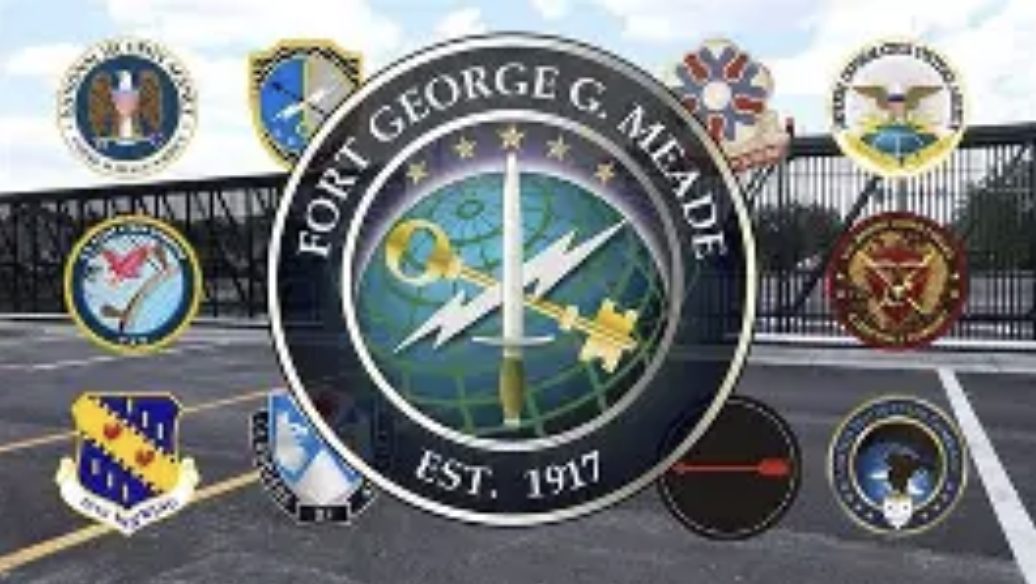
Ft. Meade, Maryland, was my birthplace, and I was born right in the window of time that made me a candidate for the West Point Class of 1969.  My father had served in North Africa and Italy during World War II, and he was stationed at Ft. Meade shortly after returning home from the European Theater.  Then I came along, in the fall of 1947.

     Our family left Ft. Meade before I was a full year old, and I didn’t return to live there until this year, 2025.  My wife and I made the move from a scenic mountain home in rural Virginia to Frederick, Maryland in order to be close to our younger son and his family.

The View from Phil’s Home in Virginia

The beauty of our Virginia home was tough to leave, but being close to our son’s family was much more important.

Scenic Beauty and Wildlife in Virginia

However, one aspect of the move gave me pause: I had a modest pistol collection, and the laws in Maryland required owners of pistols to follow various procedures that left me worried that I might miss some step and get in trouble.

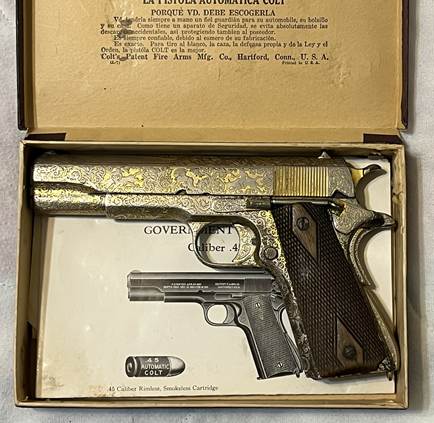
     My worries go back to my PCS (permanent change of station—a “move” of the family) in 1988 from Frankfurt, Germany to the Defense Intelligence Agency in Washington, D.C.  I had taken my three most valuable (to me) pistols with me to Germany—one that my father had captured in WWII*, one that my aunt had carried with her as a Red Cross worker in England during WWII**, and one, a beautifully engraved Colt .45 caliber automatic, that a great uncle had sold to my father***.  As the .45 automatic was my service sidearm throughout my 21-year Army career, that pistol was particularly dear to me.  All three were very special to me, and that’s why I took them with me to Germany instead of storing them somewhere in the States during my three-year tour of duty in Frankfurt.
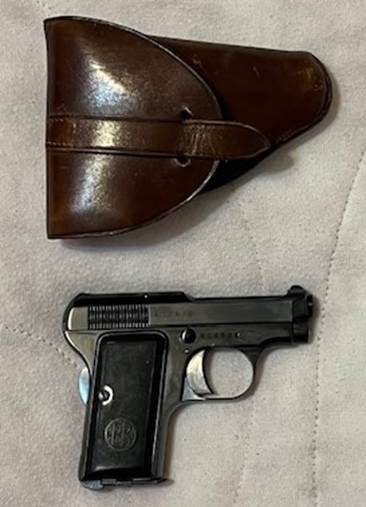
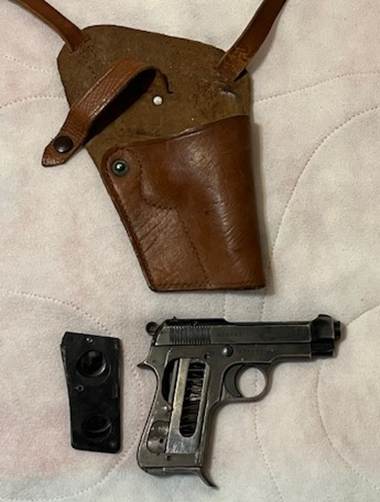
.25 Beretta from WWII*
  Aunt’s 9mm Beretta**
Colt .45 Automatic Engraved and Used Extensively by Robert C. Staley in the 1920’s and 30’s***

     The U.S. Army contracts with commercial moving firms for moving a family’s household goods from one station to another, and sometimes the contractors are not the best.  Damage was to be expected, theft was not unusual, and there was a saying in those days: “Three moves equals one fire.”  As I prepared to move back to the States in 1988, I pondered the risk of having my pistols stolen, and I decided to take them with me in my luggage.  The procedures for taking weapons in luggage on airlines are strict, but I followed them and had no difficulty.  However, customs at Dulles Airport was different.  I was in uniform and with my family, and I had two official firearm forms listing the weapons, but the customs agent confiscated all three pistols because I was missing a form that the customs agent said was required.  My protests were useless.  The customs agent informed me how I might get the pistols back by visiting a certain office in D.C.

     Fortunately, since my new duty station was D.C., visiting the office was not greatly inconvenient.  When I went to the office, on an upper floor in one of the big federal buildings in the city — after phone calls, etc. — I encountered a polite civilian who opened a safe and gave me my pistols.  He commented, “They should not have taken these from you.”  Small comfort.

     So, maybe I’m “gun shy,” but I never want to encounter something like that again.

     As we finalized our move to Maryland in March, I pondered how to find a new home for my pistols.  My children don’t want them, so I arranged for a cousin to take my collection.  He’s a generation younger than I, and he very much appreciates the firearms, which range from a rare homemade Civil War pistol to the service sidearm standard in the Army in the early 2000’s.

     We members of the Class of 1969 chose “the profession of arms.”  None of us is perfect, and our civilian masters aren’t perfect.  We have to do the best we can but make allowances for the inevitable imperfections and move on.  My way to deal with my pistol collection, and the possibility that I might inadvertently violate Maryland’s laws, was to give away the collection.  It’s still “in the family,” and it’s in the hands of the next generation.  I’m comfortable with that.

*My father “captured” the pistol when his field hospital occupied a hospital in Italy, where the retreating Axis forces had left not only patients (who were then cared for by my father’s unit) but a significant quantity of military supplies.  At the time, my father was the Headquarters Company commander of the field hospital.  The .25 caliber Beretta was the standard sidearm of certain Italian officers; this particular pistol was brand new, still in cosmoline.

**My aunt served in the Red Cross, primarily in London, during WWII.  Her Red Cross career extended well into the 1980’s and included a tour of duty in Vietnam.  Her tour of duty there overlapped with my tour of duty with the 101st Airborne (Airmobile) Division.  However, because of the distance between us (she was in the Saigon area, and I was at Camp Eagle, near Hue City) and the demands on both of us, we never got together in Vietnam.

***That great uncle was Robert C. Staley, a real old-time Texas lawman with several experiences through which he barely kept his life.  This Colt .45 was the sidearm he used most during his three careers. Uncle Bob wrote the history of each of the guns he sold to my father, and here is a verbatim excerpt from his history of the Colt .45: “The right-hand walnut grip on this gun is inlaid with GI issue eagles, plus my initials RCS and USBP in ivory.  In my younger, more foolish days, I once backed up to the piano in Mrs. Crosby’s saloon in Villa Acuña, Mexico and reaching back pried a couple ivory keys from it.  Then I made the above inlays from one of them.  At the time I did this the “USBP” of course meant United States Border Patrol.  Later–years later, and purely by chance I entered the Prohibition Service and the inlay held good–United States Bureau Prohibition.  Then, of all things, after the country went dry, and I was out of work, I took a job (until fired) with the U.S. Bureau of Prisons at La Tuna, Tex, north of El Paso, and again USBP was fully applicable.  Funny how things happen isn’t it.  It seems so damned unlikely that such a thing would occur–like it was “pre-destined.”
Written by Suzanne Rice · Categorized: By Phil Clark

Mar 09 2022

Country – A View from Abroad – 1975

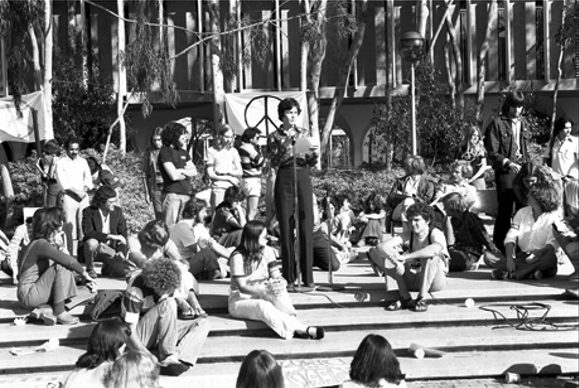
      The University of Bonn had the reputation, among West German universities in the mid-1970’s, of being relatively conservative and orderly.  However, when I was privileged to study there beginning in the fall of 1974, I was astonished at the prevalence and virulence of Marxist thought among the students.  Echos of the 1968 student revolution in western Europe still reverberated throughout the university, and anti-capitalist rhetoric was common and went largely unopposed in student discussions and throughout the student social scene.

German Student Demonstrations in 1968 (Field Journal)

    However, most of the lectures and seminars that I attended, in history and political science, were led by professors who presented balanced, responsible scholarship.  It was not unusual for activist students to “take over” a lecture just before a class would begin, occupying the front of the classroom and insisting on the necessity and urgency of social solidarity and action to oppose capitalist propaganda.  When this happened, the typical professor would walk in, move to the front of the classroom, wait a couple of minutes with modesty and dignified patience, and then interrupt the student and suggest that it was perhaps time for him to have a turn and present his lesson. Activist students sometimes tried to carry on, but students in the classroom usually showed a preference to have the professor do the lecturing.  In spite of the passion with which the activist students asserted themselves, such confrontations–at least the ones I witnessed–were peaceful, lacking even a suggestion of physical intimidation, and spectator students in the classroom were normally dispassionate regardless of their social/political leanings.

     Only once did I see a professor get excited and angry when this kind of thing happened, but that one exception was memorable.  It was a lecture in a regular political science course by Professor Krazewski, a visiting professor from Poland.  At the time, Poland was part of the Soviet empire, behind the Iron Curtain.

Poland Behind the Iron Curtain (Weebly.com)

     Prof. Krazewski had arrived at the University of Bonn in the fall of 1974. The fact that the Polish regime (and the Soviet Union) had permitted his year-long residence and teaching in West Germany suggested to me that he was a reliable Communist, with a thoroughly Marxist/Leninist interpretation of history and international relations.  That’s why I wanted to hear his lectures.  (Know your enemy.)

     At the end of April and on 1 May 1975, the last of the U.S. presence in Vietnam ended in the ignominious rout that we of the Class of 1969 remember so vividly. At the University of Bonn, students were gleeful–the underdog communist North Vietnamese had prevailed over the neocolonial imperialist United States of America. Gathering for Prof. Krazewski’s lecture that day (my notes taken at the time show it was 29 April 1975), the students were raucous, celebrating as the class was about to begin, and several students had occupied the front of the classroom and wanted the professor to celebrate with them and change his topic to the war in Vietnam and the defeat of the United States.

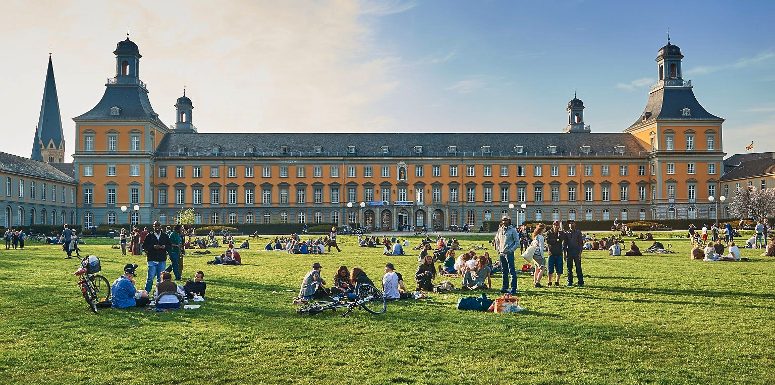
Typical Classroom at the University of Bonn (Volker Lannert / Universität Bonn)

     Prof. Krazewski was not amused. He became angry and berated the students, accusing them of immature foolishness and of failing to understand what that war had meant for the Communist movement. He said that tremendous resources had flowed from Poland and the other satellite states to fight the United States in Vietnam, and the economic impact had been devastating; if it had not been for that war, the Soviet Union would have beat the United States to the Moon.

    Angry overstatement? A narrow and prejudiced view from a member of the Polish “nomenklatura” who had been denied the standard of living so evident in the West?  I don’t know.  But I have never forgotten his reaction to the students, who were so sure that they were witnessing a huge milestone in the worldwide struggle for social justice. Prof. Krazewski helped them toward an understanding: it’s not so simple.  The economic effect of the war on the Soviet empire was enormous and stressful. And I believe it’s not wrong to say that it was the social and economic pressure of our country on the Soviet empire that won the Cold War.

    While attending the university, I tried to be modest and blend in as just a student, but I made no secret of the fact that I was an active-duty Captain in the U.S. Army.  As a class was about to start on 1 May, after news reached the world of the departure of the last American helicopters, one of the student activists addressed me.  He was not trying to denigrate me, but his tone was, “America deserved this outcome, and we told you so.”  I responded that four U.S. administrations of both political parties, had tried to defend a semblance of South Vietnamese freedom in the face of North Vietnam’s military aggression, so it wasn’t just one cabal of American capitalists manipulating the public and pursuing profits.  He hadn’t thought of it that way, and it quieted him some.

    Our country is certainly not always “right,” as each of us has seen in our lifetimes of service to her. Still, there is a lot of good that results from the high ideals that the United States stands for and that we accepted upon graduation and have worked to further. And perhaps even in some of our worst failures, the ideals we try to uphold prevail and make our country better.

Written by Suzanne Rice · Categorized: By Phil Clark

Footer

Historians and other inquiries.

Submit a Form

Join our community.
Subscribe to Our Bulletin

Copyright © 2026 · Site by RK Studios