Ft. Meade, Maryland, was my birthplace, and I was born right in the window of time that made me a candidate for the West Point Class of 1969. My father had served in North Africa and Italy during World War II, and he was stationed at Ft. Meade shortly after returning home from the European Theater. Then I came along, in the fall of 1947.
Our family left Ft. Meade before I was a full year old, and I didn’t return to live there until this year, 2025. My wife and I made the move from a scenic mountain home in rural Virginia to Frederick, Maryland in order to be close to our younger son and his family.

The beauty of our Virginia home was tough to leave, but being close to our son’s family was much more important.
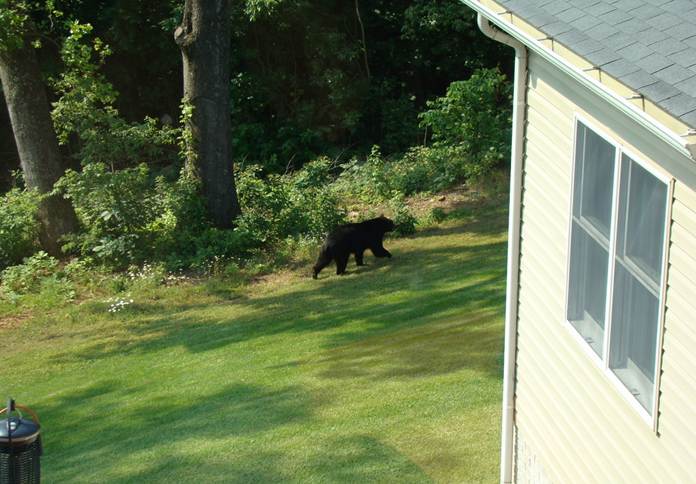
However, one aspect of the move gave me pause: I had a modest pistol collection, and the laws in Maryland required owners of pistols to follow various procedures that left me worried that I might miss some step and get in trouble.
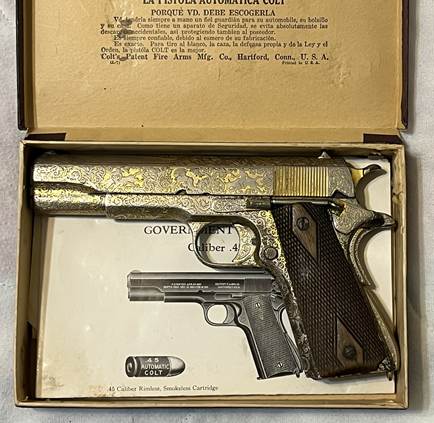
My worries go back to my PCS (permanent change of station—a “move” of the family) in 1988 from Frankfurt, Germany to the Defense Intelligence Agency in Washington, D.C. I had taken my three most valuable (to me) pistols with me to Germany—one that my father had captured in WWII*, one that my aunt had carried with her as a Red Cross worker in England during WWII**, and one, a beautifully engraved Colt .45 caliber automatic, that a great uncle had sold to my father***. As the .45 automatic was my service sidearm throughout my 21-year Army career, that pistol was particularly dear to me. All three were very special to me, and that’s why I took them with me to Germany instead of storing them somewhere in the States during my three-year tour of duty in Frankfurt.
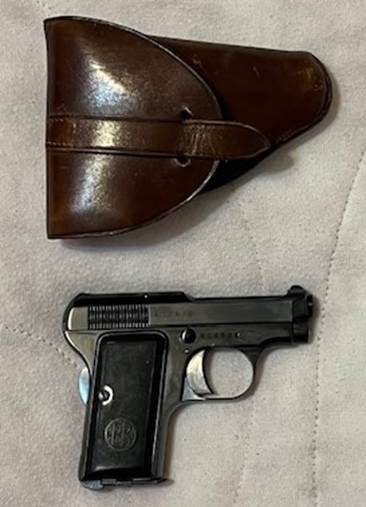
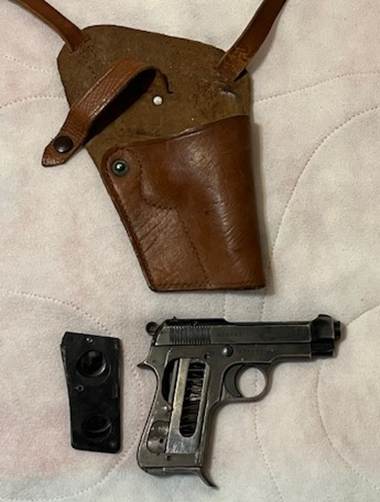
The U.S. Army contracts with commercial moving firms for moving a family’s household goods from one station to another, and sometimes the contractors are not the best. Damage was to be expected, theft was not unusual, and there was a saying in those days: “Three moves equals one fire.” As I prepared to move back to the States in 1988, I pondered the risk of having my pistols stolen, and I decided to take them with me in my luggage. The procedures for taking weapons in luggage on airlines are strict, but I followed them and had no difficulty. However, customs at Dulles Airport was different. I was in uniform and with my family, and I had two official firearm forms listing the weapons, but the customs agent confiscated all three pistols because I was missing a form that the customs agent said was required. My protests were useless. The customs agent informed me how I might get the pistols back by visiting a certain office in D.C.
Fortunately, since my new duty station was D.C., visiting the office was not greatly inconvenient. When I went to the office, on an upper floor in one of the big federal buildings in the city — after phone calls, etc. — I encountered a polite civilian who opened a safe and gave me my pistols. He commented, “They should not have taken these from you.” Small comfort.
So, maybe I’m “gun shy,” but I never want to encounter something like that again.
As we finalized our move to Maryland in March, I pondered how to find a new home for my pistols. My children don’t want them, so I arranged for a cousin to take my collection. He’s a generation younger than I, and he very much appreciates the firearms, which range from a rare homemade Civil War pistol to the service sidearm standard in the Army in the early 2000’s.
We members of the Class of 1969 chose “the profession of arms.” None of us is perfect, and our civilian masters aren’t perfect. We have to do the best we can but make allowances for the inevitable imperfections and move on. My way to deal with my pistol collection, and the possibility that I might inadvertently violate Maryland’s laws, was to give away the collection. It’s still “in the family,” and it’s in the hands of the next generation. I’m comfortable with that.
*My father “captured” the pistol when his field hospital occupied a hospital in Italy, where the retreating Axis forces had left not only patients (who were then cared for by my father’s unit) but a significant quantity of military supplies. At the time, my father was the Headquarters Company commander of the field hospital. The .25 caliber Beretta was the standard sidearm of certain Italian officers; this particular pistol was brand new, still in cosmoline.
**My aunt served in the Red Cross, primarily in London, during WWII. Her Red Cross career extended well into the 1980’s and included a tour of duty in Vietnam. Her tour of duty there overlapped with my tour of duty with the 101st Airborne (Airmobile) Division. However, because of the distance between us (she was in the Saigon area, and I was at Camp Eagle, near Hue City) and the demands on both of us, we never got together in Vietnam.
***That great uncle was Robert C. Staley, a real old-time Texas lawman with several experiences through which he barely kept his life. This Colt .45 was the sidearm he used most during his three careers. Uncle Bob wrote the history of each of the guns he sold to my father, and here is a verbatim excerpt from his history of the Colt .45: “The right-hand walnut grip on this gun is inlaid with GI issue eagles, plus my initials RCS and USBP in ivory. In my younger, more foolish days, I once backed up to the piano in Mrs. Crosby’s saloon in Villa Acuña, Mexico and reaching back pried a couple ivory keys from it. Then I made the above inlays from one of them. At the time I did this the “USBP” of course meant United States Border Patrol. Later–years later, and purely by chance I entered the Prohibition Service and the inlay held good–United States Bureau Prohibition. Then, of all things, after the country went dry, and I was out of work, I took a job (until fired) with the U.S. Bureau of Prisons at La Tuna, Tex, north of El Paso, and again USBP was fully applicable. Funny how things happen isn’t it. It seems so damned unlikely that such a thing would occur–like it was “pre-destined.”
At the time of the Revolutionary War, the American Pennsylvania [or Kentucky] Long Rifle was the most sophisticated infantry weapon in the world. When Daniel Morgan organized his volunteer Brigade of Riflemen, each candidate brought his own rifle and had to place three successive rounds at 100 yards that could all be covered by a silver dollar.
Morgan’s Riflemen served as snipers, climbing trees and picking off British officers and artillerymen from 200 yards distance. The only problem was the rifle was slow to load. That’s how my 7-greats grandfather died at First Saratoga in 1777 — he couldn’t get out of the tree in time to avoid a bayonet charge.
Gun smiths were the backbone of American settlement west of the Appalachians. Most were of Scots-Irish heritage, who had vowed from their experience in Britain they would never again be deprived of weapons. They refused to sign on to the new Constitution until a guarantee was inserted that the government could never seize their weapons.
And that heritage lives on today among people such as you, Phil. Drive on.
— guy
Guy E. Miller
Guy — Your reaction and Phil’s narrative help me better appreciate the passion and devotion gun owners embody. This prompted my research into the slogan Charlton Heston made famous at the 2000 NRA convention. That in turn led AI to recall this:
“In the 1997 movie Men in Black, a farmer tells an alien, “You can have my gun when you pry it from my cold, dead fingers,” to which the alien replies, “Your proposal is acceptable,” before killing him.”
Lesson learned. My thanks to you and Phil for your posts. Be the BOTL.
Dear Phil and Guy:
Phil, thanks for the interesting story and quote: “Three moves equals one fire.” 4WIW, throughout my dad’s career in the Army, he avoided theft and overweight-charge problems by making friends with the movers. Unfortunately, several times and unbeknownst to me until much later, this was at my expense. The first time, he gave them my fishing reel; the second, my steel-string guitar! : ) : ( : )
Guy, thanks for the history regarding the long rifle. Yes, not only were they slow to load (maybe one shot per minute) versus the several shots per minute of the musket, but they could not fit a bayonet. Hence, when the British charged, you either had to run or risk breaking your beautiful, expensive rifle while using it (just once?) as a club.
Thanks again!
Best regards & BOTL,
Bill
P.S. For those interested in Rev War weapons: http://www.bahrnoproducts.com/Charleville_Firing_and_Cleaning.htm
Thank you, Phil, for your story!
A most interesting article Phil. Virginia used to be a better location than Maryland for weapons, but that recently changed. It never ceases to amaze me that the anti-Second Amendment people think by passing laws., the bad guys are going to comply with them. If you have certain antique weapons, you might think about placing them in a trust or getting a Federal Firearms License (FFL) as a collector.
I am not a firearms collector, but I currently own 3 pistols, so I loved your story, Phil. And I fully understand your reluctance to go afoul of Maryland law. It is truly a notorious state amongst those of us who own guns. The funny thing is that owning firearms is only something that I have gotten into in the past 15 years or so. All through my military career I never had any, but in the past 15 years I’ve probably owned 8-10 different ones with my current holdings consisting of a Walther PP .32, an Iver-Johmson .22 and a Beretta .32.
Thank you for your article, Phil. It brought back some memories for me. My Dad also served in WWII in North Africa and Italy, where he also “captured” a German pistol. After his death, my Mom had it for several years, and I foolishly told her I did not want it. A big mistake on my part.
Glad you found a good home for your three firearms.