• Skip to main content
  • Skip to footer

The Days Forward

West Point Class of 1969

  • Starting Out
    • Reception Day
    • Making the Cut
    • Becoming a Cadet
    • Where Did They Go?
  • Browse the Stories
    • Authors
    • Map
    • Search
    • Archive
  • Contact

Suzanne Rice

Aug 13 2019

Class Rank Matters – 1975

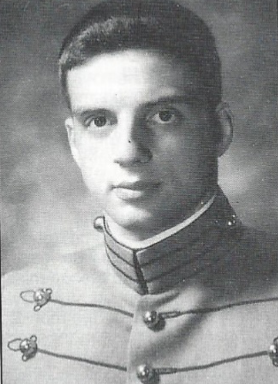
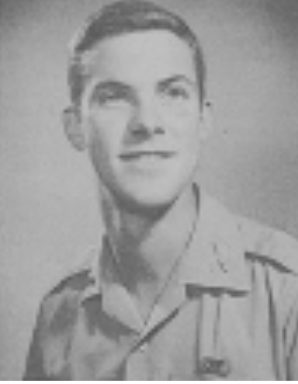
Jim Bachta was our perennial Brigade Boxing Champ at 132 lbs1.  He graduated 189th in our class.  I was 35 files behind him at 224.2
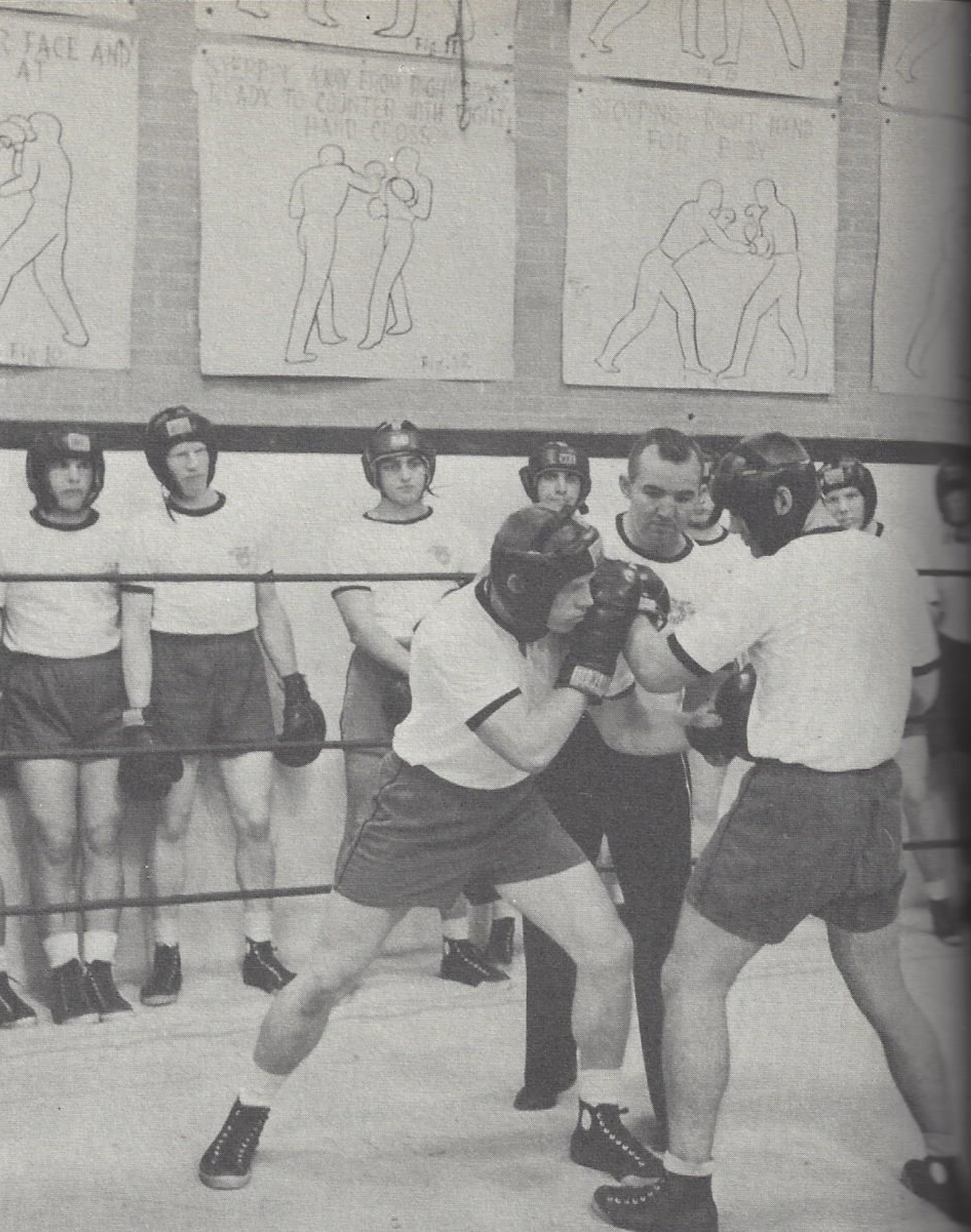
Cadets Competing at West Point
Cadets Competing in the Brigade Championship

We both branched Armor.  Luck of the draw moved us nearly simultaneously from the Armor Officer Basic course to Airborne School (where we shared an apartment with classmates Lew Riggsby and Don Smith) and Ranger School to a tour in Germany to a tour in Vietnam to a second tour in Germany.  During the second tour in Germany, we’d occasionally weekend together, touring parts of Europe we could reach on our BMW motorcycles.  One summer we traversed North Africa, which is another story.

When the Army had finished with us in 1975, we moved into an apartment near Heidelberg and enrolled in an international relation master’s degree program, intending to find civilian work that would allow us to stay in Germany.  It turned out that employers were hiring only MBAs for the interesting jobs.  We should have checked first!  We dutifully got ourselves into the MBA program at Stanford, and again rented a place together off-campus.  Among the things the sparsely furnished house lacked was a coffee maker.

To economize, we went looking for a used Mr. Coffee at the local Goodwill store.

Good Will West Point Jim
Goodwill Store 

We found three.  One looked much better than the other two.  I picked up the nice one and headed toward the cash register.  “Just a minute,” says Jim.  “Maybe, we should plug it in first, to at least see whether the little pilot light comes on.”  I thought that was overdoing it for so simple a device, but out of respect for my classmate and friend, I sought out a power outlet.

When I plugged in the nice-looking Mr. Coffee and switched it on, we heard a large circuit breaker nearby open, and all the overhead lights went dark.  And no pilot light on our Mr. Coffee.
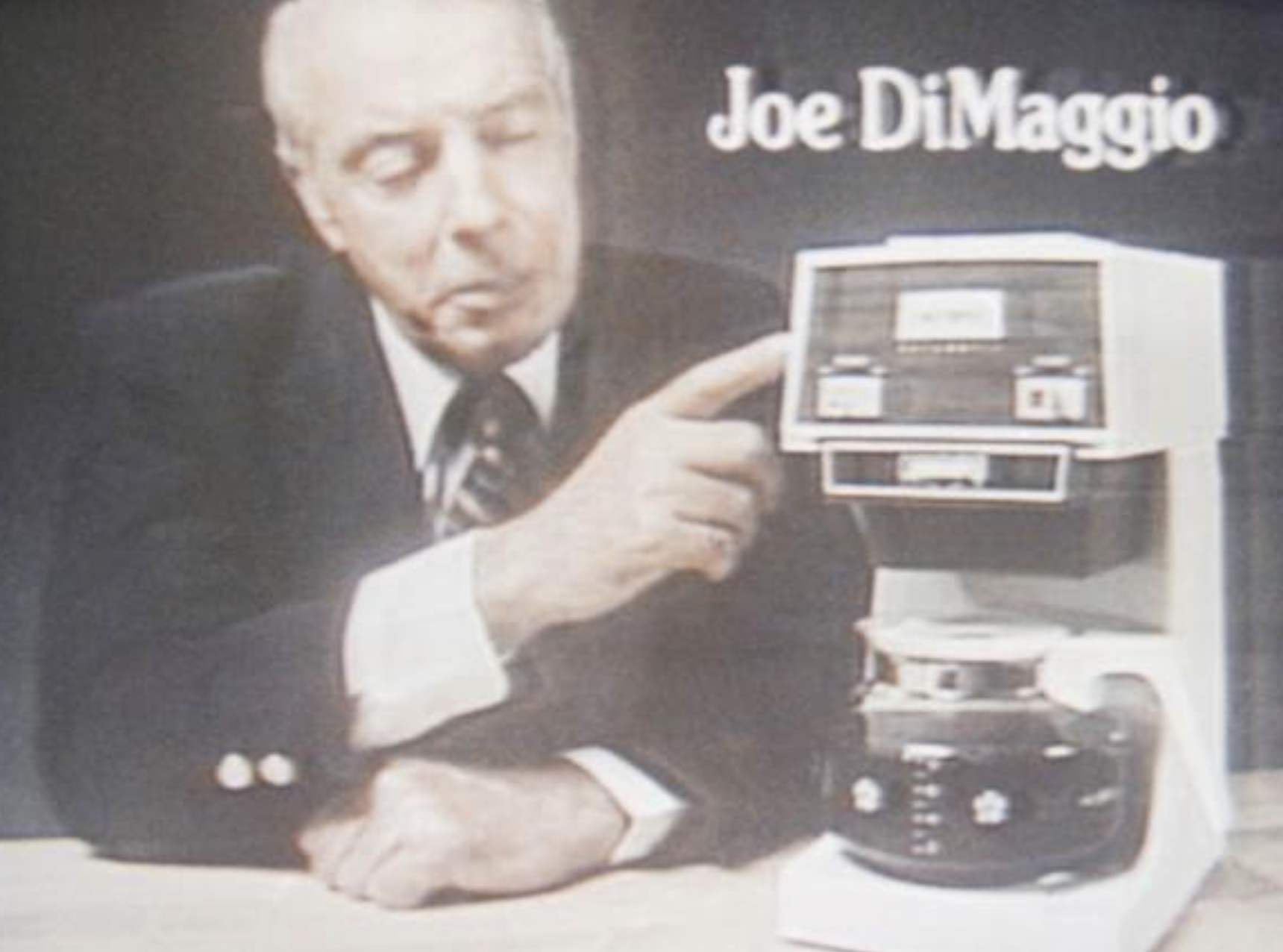
West Point Coffee
Spokesman Joe DiMaggio recommends Mr. Coffee

We told the staff about that defective Mr. Coffee, and selected one of the scruffy ones to replace it.  When the store lights came back on, we plugged that one in.  The little pilot light came on nicely, and the hotplate under the pot began to warm up. The store lights stayed on. We bought that one – $6, I think – and took it home.  It was still working fine when we graduated from business school 18 months later.  We donated it to the rental house.

The lesson:  Class rank matters. 
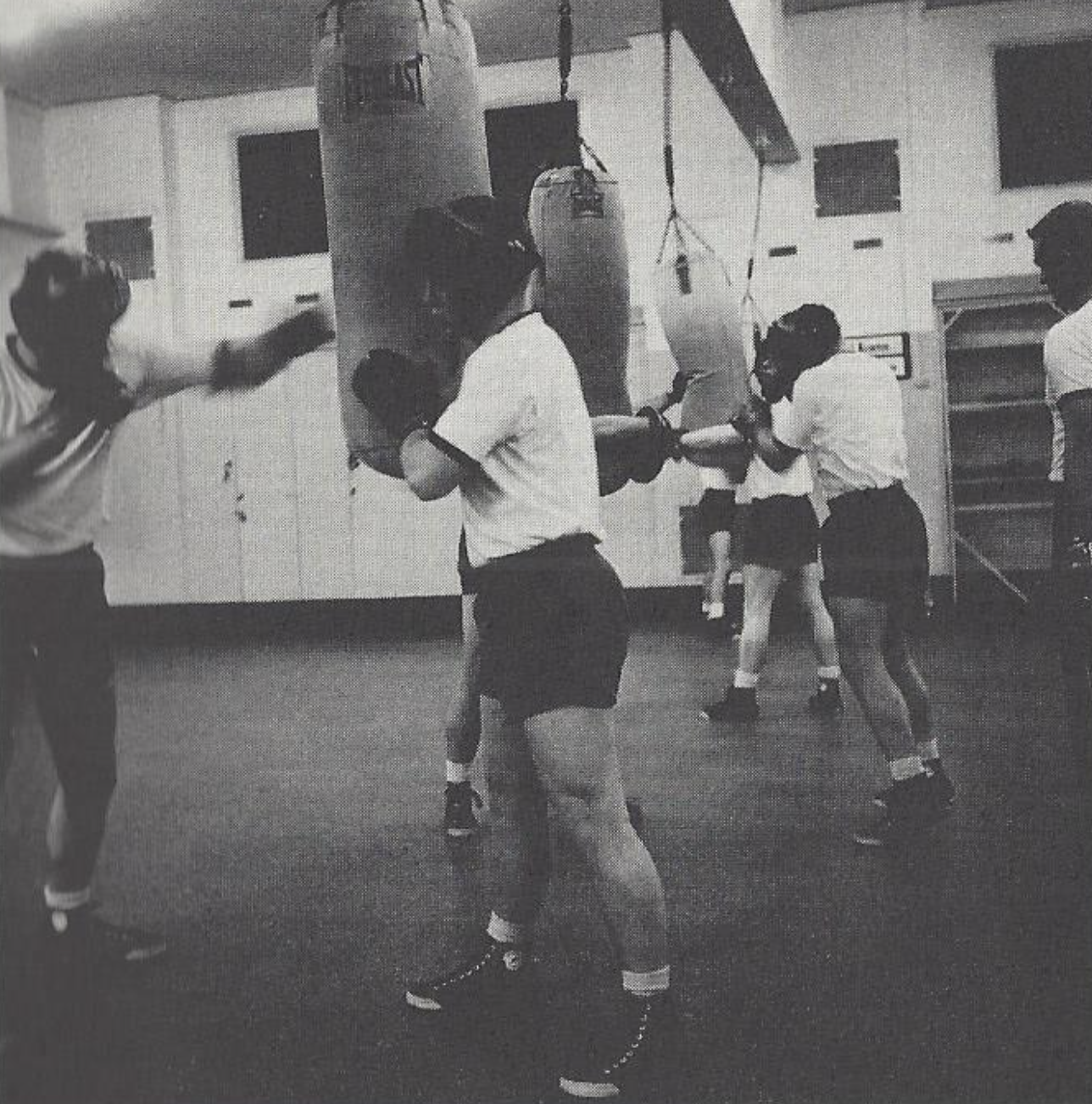
Cadets Boxing Class
Cadets in Boxing Class

Notes:

  1. Boxing was and remains a mandatory plebe (Freshman) physical education course, and also a winter intramural sport. The best boxers are encouraged to enter the annual Brigade Open Boxing Tournament, where single-elimination matches determine a brigade champion in each weight class. Unlike most other sports at West Point, boxing was new to practically everyone, so it was a good measure of native athletic ability.  Usually cows (Juniors) or firsties (Seniors) won these individual brigade championships, because it took experience to develop the skills. Jim Bachta was an exception to the rule. He won the championship during his plebe, yearling (Sophomore), and firstie years.  During cow year, he had broken his nose sparring with Jim McDonough, a heavier classmate and, I think, our only Golden Gloves alumnus. The boxing program in 2019 is similar, with two additions:  1. When women joined the Corps in 1976, they initially took a female-oriented self-defense course in lieu of boxing.  Over time they demonstrated their toughness and lobbied for taking the same boxing course as the men.  From 2016, they have taken the same boxing program as the men, boxing other women.  2. In 1976, boxing returned to the intercollegiate sports world with the birth of the National Collegiate Boxing Association.  Army has fielded a team from the beginning of this era, and is consistently dominant, having won seven national championships.  At this writing, Army is the defending national champ.
  1. Class rank: Most things cadets do – academics, leadership, sports – are graded in one way or another.  These grades are continuously tracked and combined into a single evaluation, “General Order of Merit”.  Individuals’ GOM scores are rank-ordered to determine class rank. For firsties, class rank determined order of selection for branch and first duty station.  At graduation, we received our diplomas in order of class rank.  Everyone’s class rank was published, and we all knew well where we stood.  Although class rank has other components, academics are most important.  We commonly gauged our classmates’ intellectual capacity by their class rank.

Cadet photos courtesy of the Jack Engeman Collection, the Photography Collections, University of Maryland, Baltimore County
Written by Suzanne Rice · Categorized: By Jim Russell

Jun 11 2019

Until the Storm Is Over – 2018

In the spring of 2018, Sallie and I accompanied our granddaughter’s school outing on a field trip to France and Belgium to honor the end of the First World War. The trip schedule took us to Normandy, also, to see the Normandy beaches and other sites of the invasion.

As you would expect, we visited the Normandy US cemetery. But my story begins back before we left. We did research on local Oconee County veterans who were buried at Normandy and, in particular, that were killed on or about D-Day, 1944. There were only a few, but one was to stand out and humble me forever, Pvt. James B. McDaniel.

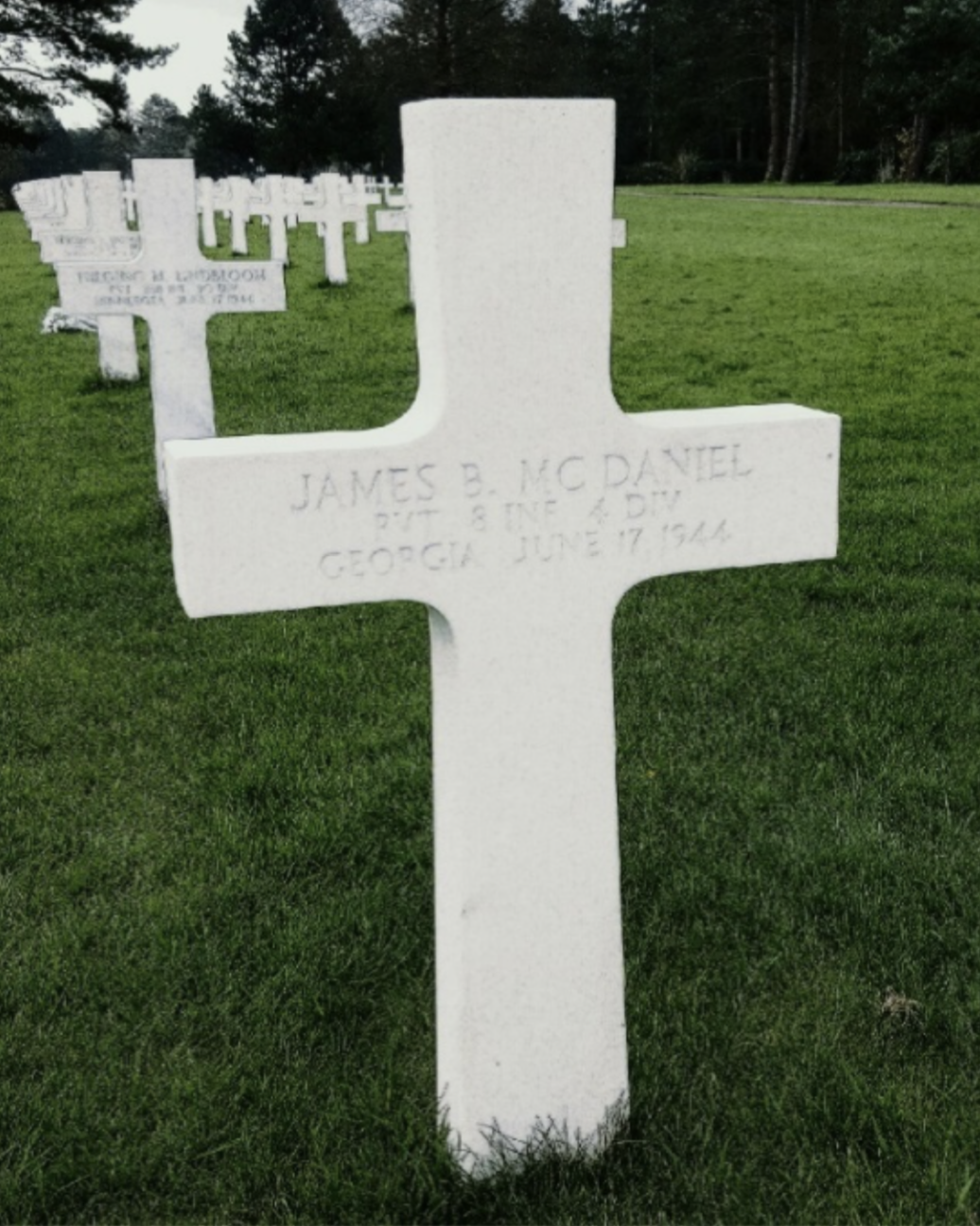
At Normandy, luckily, as the rain had fallen steadily for several days and walking on the grass was discouraged, we found his grave site and took a photo.

Final resting place of PVT McDaniel

When I returned home, a local paper wanted to interview me about the trip and the photos, and I agreed. As I prepped for the reporter interview, I begin to wonder: are there any relatives of Pvt McDaniel still here in the area? So, I begin to search using an online genealogy tool. After being discouraged somewhat, the ancestry tool came through. Literally, on Memorial Day 2018, I discovered that, indeed, his widow, Helen McDaniel, was still alive and living about 30 minutes away. I decided to pay her a visit. My wife said, “be sure to take flowers!”

So, away I went to Winder, GA. I found her house- no one home. Then I remembered the genealogy tool had given me a phone number, so I called her number and listened for it ringing inside the house. Not a sound. Just when I was about to give up, she answered.

“‘Hello’. Ms. McDaniel?
Yes.
Ms McDaniel. My name is Dick Wallace and I am at your house. Are you home?
You are at my house? Well, I don’t need anything. Thank you. I don’t want to buy anything.
Ms. McDaniel. No, you misunderstand. I don’t want to sell you anything. I was just in France and I have a photo of your husband’s gravesite at Normandy. And I have you some flowers! I would like to give them to you.
You have flowers for me?!
Yes, ma’am. Can I come see you?
Well, I am in a retirement home now. I had stroke about five years ago and had to move out of my house.
That’s ok- where are you located, and I will come by.
Well, it’s Magnolia Estates. Not too far. But lunch is at noon. (It was about 1115 now)
Yes, ma’am and I will be there right away. I won’t interfere with your lunch.
Ok, then.”

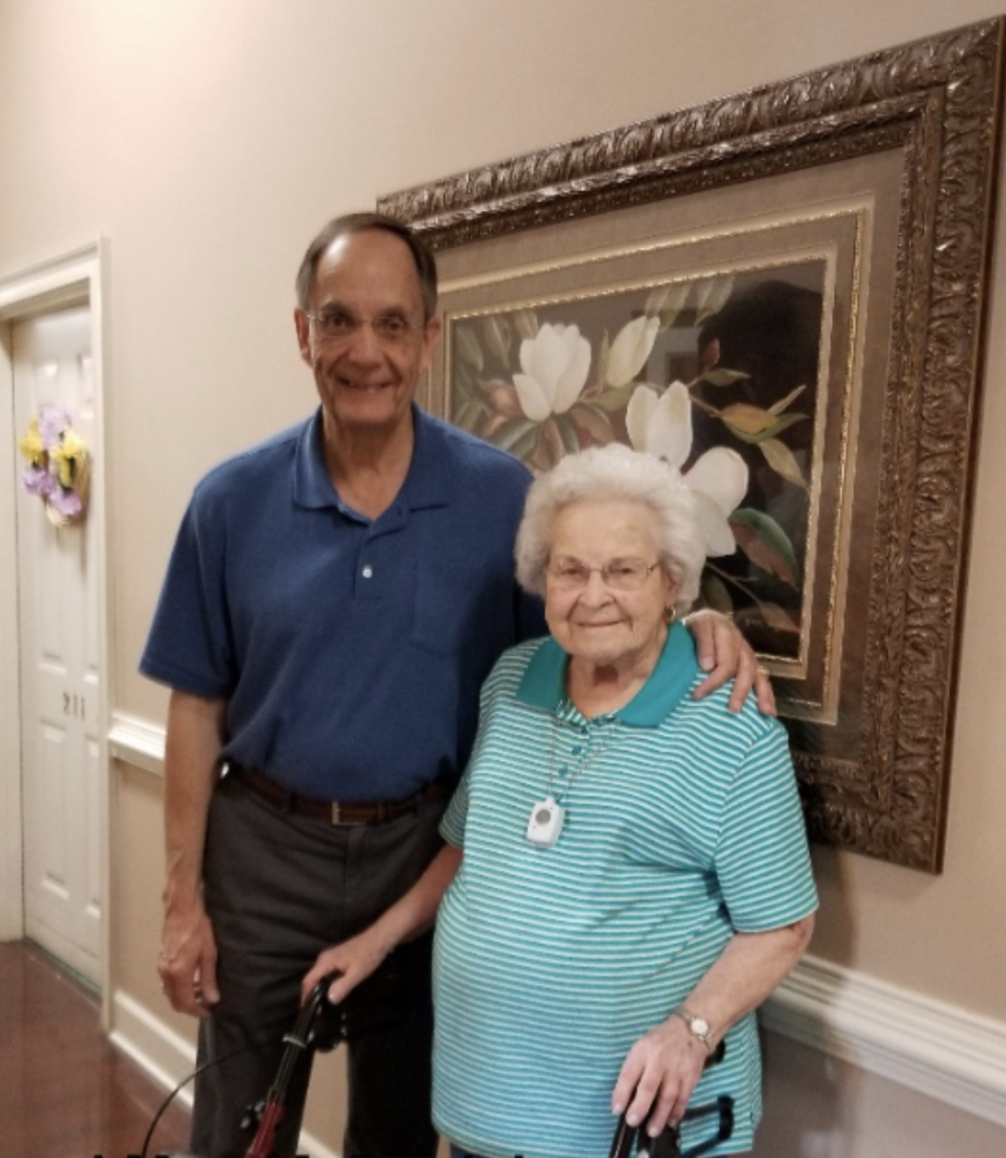
So off I went to Magnolia Estates and found it easily. As I walked up to the front doors, they begin to open from the inside and as I pulled them all the way open there stood Ms. McDaniel, pushing the door open with her walker.

Dick and Mrs. McDaniel

After the greetings with staff, she escorted me back to her room and there is where this story took a turn.

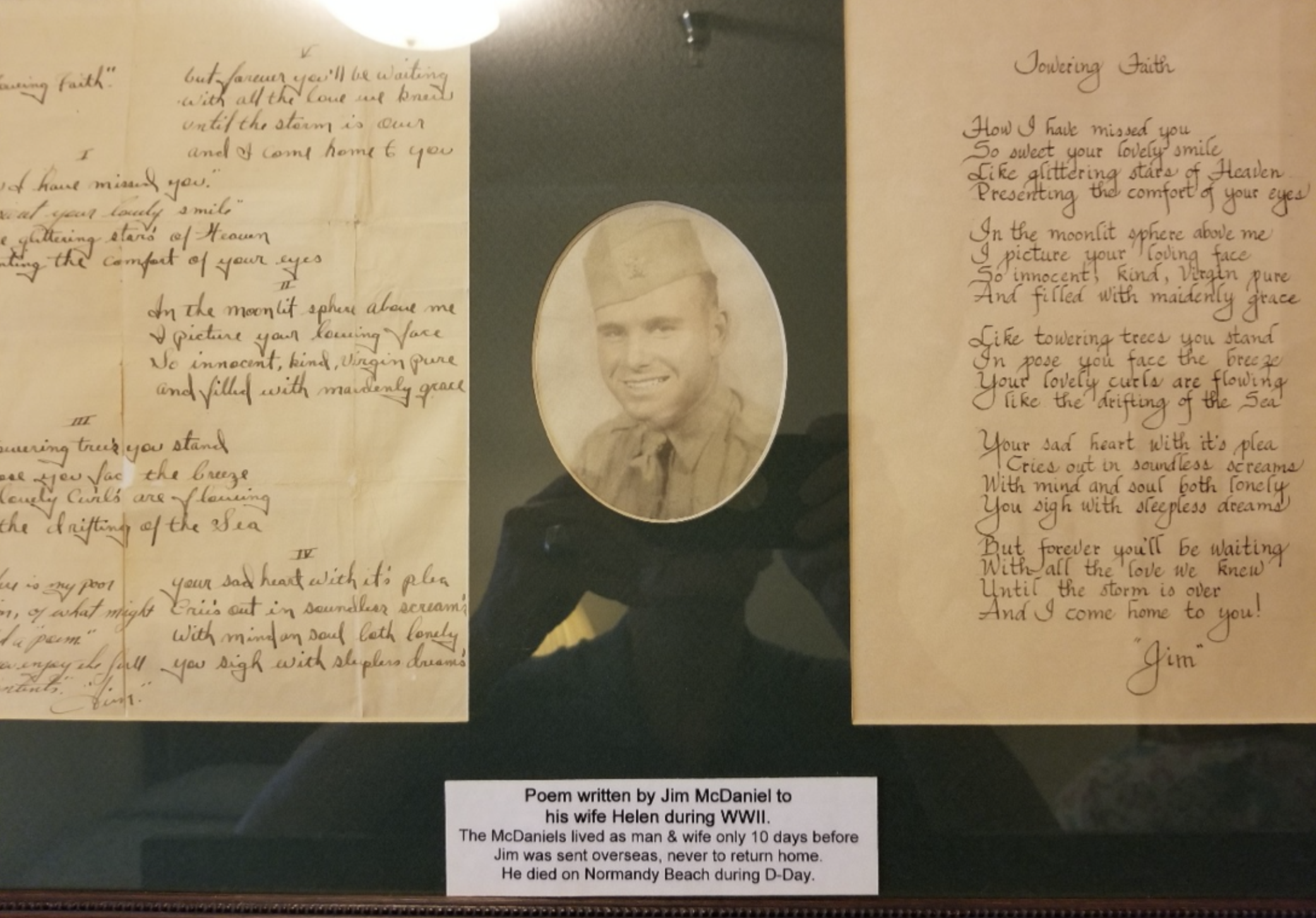
She sat in her big easy chair and across from her on the wall was a collage of memories and photo of her husband, James. She told me their love story and how they had been married only 10 days before he deployed to France.

“A bride at 18 and a widow at 18” she lamented. She never remarried.

But what tore at my heart most was the last letter she received from James just before he left for Normandy. In fact, it was a poem and she had framed the original and also a calligraphy copy a friend had made for her. The words are below:

Towering Faith

How I have missed you
So sweet your lovely smile
Like glittering stars of heaven
Presenting the comfort of your eyes.

In the moonlight sphere above me
I picture your loving face.
So innocent, kind, virgin, pure
And filled with maidenly grace.

Like towering trees you stand
In pose you face the breeze
Your lovely curls are flowing
Like the drifting of the sea.

Your sad heart with its plea
Cries out in soundless screams
With mind and soul both lonely
You sigh with sleepless dreams.

But forever you’ll be waiting
With all the love we knew
Until the storm is over
And I come home to you!

‘ Jim ’


She shared that she was able to communicate in writing to Jim’s good wartime buddy. His biggest revelation was that Mac had died on the 10th of June, not the 17th in the Army record. He knew that for a fact because the German mortars that wounded him had killed James. But she took the Army’s dates for record and every 17th of June honored him with altar flowers in their local church.

She invited me to stay for lunch with her. I did, of course. And she liked my flowers!

The local paper printed her story and more.

Leaving, I was humbled and awed at the immensity of their sacrifice- all of their tomorrows and dreams gone that momentous day back in 1944. No national treasure can repay. And they are only one of those who shared the same sacrifice.

For my own catharsis I wrote a letter to her husband. Civilization owes a great debt to the James and Helen McDaniel’s of that generation.

I still visit with her from time to time.

Letter to Pvt. James B. McDaniel; KIA Normandy France June 1944
Dear Pvt. McDaniel,
I met your widow today, Mac. I report that she still holds your memory dear. The poem you wrote to her from England, Towering Faith, hangs on her wall, along with a calligraphy copy lovingly done by a friend or relative. A reader comes to tears upon reading. And, of course, your photo is center set among the poems and rests above the memorial flag sent to her in commemoration of your sacrifice. I note you were married only ten days before you left for France.
You know, Helen never remarried. I can only surmise you were her first and deepest love and she couldn’t really replace it with another. She honors your death every June 10. Yes, June 10th. Your buddy, Bill Koch, told her he was with you when you were killed, the same moment he was wounded. You both were hiding in the hedgerows we have heard so much about since, and German artillery took your life. The Army reports your death as June 17th but Helen relies on Bill’s recollection.
Helen has been surrounded by loving family, however, all her life: her mom and dad, nieces and nephews and sisters and brother. From her picture collage in her room, there are photos of church lady friends also. I can also tell you they are all Georgia fans as many graduated from Georgia, Helen proudly recounts.
A former mayor of Winder and his wife took Helen to visit you in Normandy many years ago, maybe she said 1995. The cemetery caretaker there put sand into the marble inscription on your resting place marker so that she could get a clear photo. Otherwise, your name was indecipherable from the blazing white marble. I think there is some symbolism there.
Pvt. McDaniel, I am so grateful, as is your nation, for the sacrifice you and Helen have made for our country. You two sacrificed all of your tomorrows together and all the memories those future days would hold and create- children, grandchildren, ball games, recitals, careers, and your Memorial Days at the beach, perhaps. There is no national treasure that can repay.
I report to you, though, that your sacrifices were not in vain as heart rending as it was to you both. The world has been and is a safer and more prosperous place; civilized and mostly at peace. Citizens of Europe and the Americas live in peace and hundreds of millions now can chart their futures guided only by their dreams; as great an epitaph as a man from Georgia could want.

Deepest, Deepest regards,
Dick Wallace
A Fellow Soldier and Georgian for all Georgians

Written by Suzanne Rice · Categorized: Dick Wallace

Jun 01 2019

Train Travel – 1994

I like to travel by train rather than plane. Many times, my wife and I have gone to Florida on a train with a Deluxe Bedroom.

Deluxe Sleeper Car

At first, that accommodation had a VCR that offered several choices of movies, and we looked forward to watching them. But apparently, they required a lot of maintenance, so Amtrak finally decided to stop using them. They also used to have a bed-time sweet, but that stopped, too. We’ve gone as far as Denver, going west, and from Glacier National Park back to New York going east. We still like the trains. It’s comfortable, we meet new people when we go to the dining car (included in our fare) which offers very good meals, and it is forced relaxation.

Amtrak Dining Car

Once, after a business trip to Boston, I was going to spend a few days with my sister Nancy and her husband “Big Bob” in nearby Winchester. So, I showed up at the commuter rail terminal and purchased a ticket. Normally, I carry all my paper money in a billfold, but this day I had a one-dollar bill in my pocket along with a substantial amount of change—more that I usually carry. The ticket cost $4.85. So, I pulled out the rumpled dollar bill and counted out another $3.85 in change and gave it all to the ticket agent. The agent said to me “Gee, did you save up for this trip.”

Another time, I was traveling alone from Rochester, NY to Poughkeepsie, NY. I boarded the 2PM train, which was two hours late, so it was about 4PM when I got on. For some reason, I prayed that the trip would be OK. It was about a six-hour trip, and after my supper I fell asleep. I woke up when people started to exit the train, and because it looked kind of like my stop, I got off with them. I got to the terminal after climbing many stairs. Then I found out that I was at Rhinecliff,
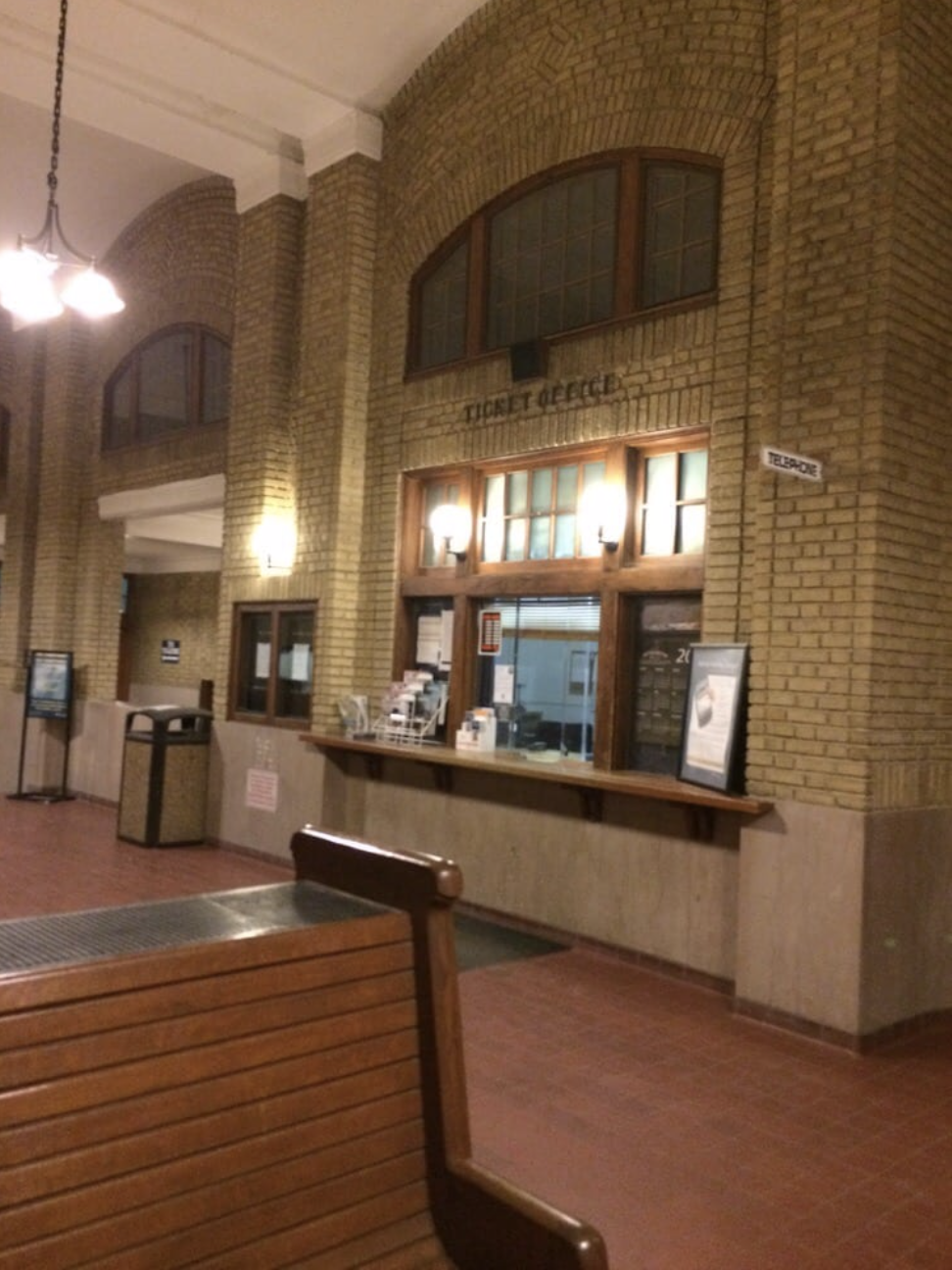
one stop before I was supposed to get off. It was supposed to be the last train of the day, according to my schedule. I asked to ticket agent for help.

Rhinecliff, NY ticket office

He told me that the train coming south from Montreal was two and a half hours late and was going to come into the station in ten minutes. I was to get on that train, explain to the conductor that I got off at the wrong stop, and go on to Poughkeepsie, and that’s what happened. I’m so glad I prayed.

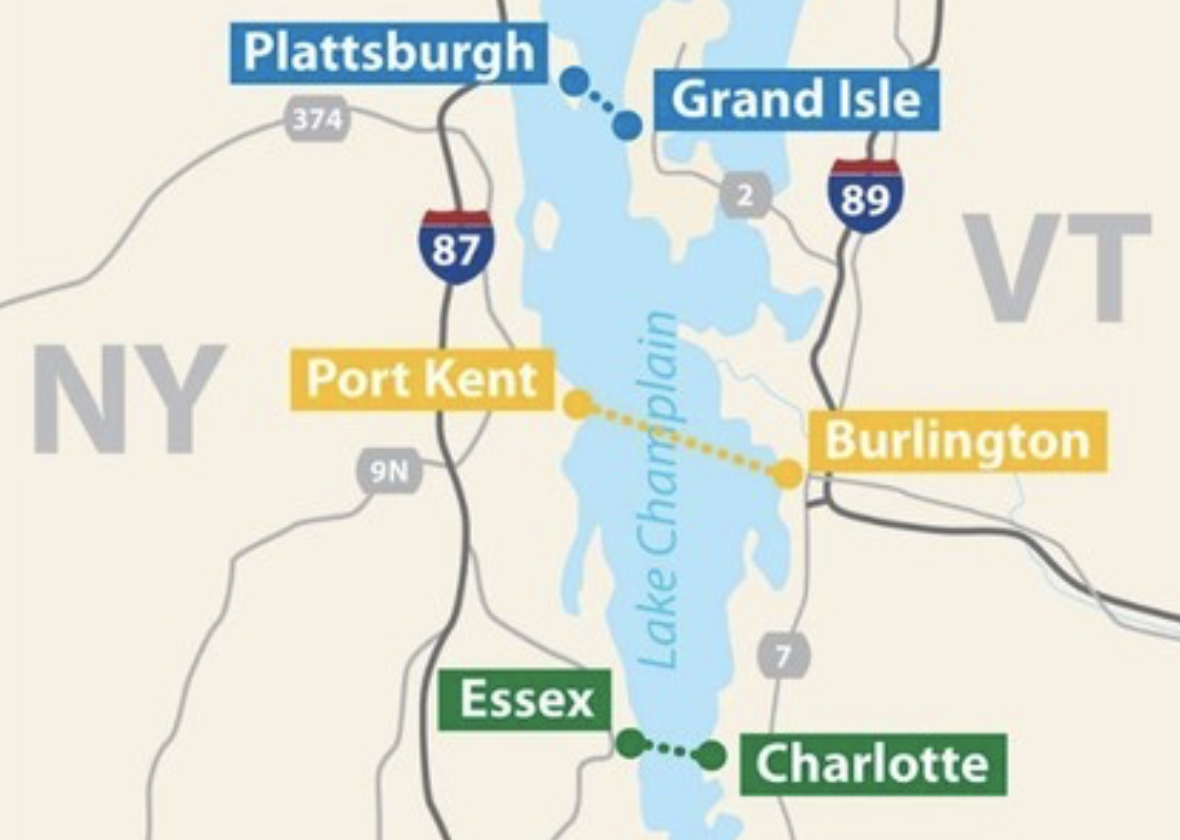
One time my wife and I traveled from Poughkeepsie to Port Kent, NY. Poughkeepsie had both Amtrak and a commuter train to New York City. The terminal was old, but grand in its day. Several hundred cars parked there every day. Port Kent, only a summer stop on the line, had a small concrete platform with a roof over a small bulletin board containing the northbound and southbound schedules. From there we were going to catch a Lake Champlain Ferry boat to Burlington, VT.

Port Kent to Burlington

We had two hours and forty minutes before the last ferry of the day, according to the train schedule, and we hoped we might catch the one that left two hours before that. The train left New York City, where it started, an hour late because of engine trouble on the original locomotive. Another one had to be obtained from Sunnyside Yard, where extra train locomotives and cars were kept. We kept that hour late until we got to Schenectady, where we split off from the line to western New York and advanced along the Lake George—Lake Champlain corridor. Some consider this the most scenic route in America. But today, we weren’t thinking about that. We were thinking that we were crawling along very slowly because of track work that was going on. Instead of seventy-nine miles an hour, we were going much slower. We thought that we still had plenty of time to catch the last ferry. But as time went on, and we kept crawling, we weren’t so sure of making the connection. We asked the conductor, who assured us that we would make it. A little while later, he came to us and said that there was another couple getting off there and wanting to take the ferry, too, and that we would make it. The next time he came through, he said that when we got within five miles of Port Kent, the engineer would blow his whistle repeatedly to alert the ferry that the train was getting close. Finally, he said on a final time through that we should pray.

As we neared the station, the conductor said he would let us off on the wrong side of the train, giving me precious extra time to run down to the ferry dock and ask them to hold off. We were between five and ten minutes later than the last ferry departure time when we got to Port Kent. I could see the ferry engines running, but it was still there.

Huffing and puffing, hauling a suitcase, I got to a deckhand and told him my wife and another couple were coming, too, and please wait. He tried to calm me down, and he and another man, possibly the first mate, explained that they knew the train hadn’t gotten there, and almost certainly there were some passengers on it that wanted to take the ferry. No matter how late the train was, they were going to wait for it, so it was no problem.

It was a nice ferry ride, across the widest part of Lake Champlain. But on the way back, eight days later, we got caught in a rainstorm and my wife and I got soaked. But we had our suitcases with us and were able to change clothes.

Wouldn’t you know, the same train conductor greeted us as we got on, asking us “Did you make the ferry?” That was so nice that he remembered us, and we told him so, and we wrote to Amtrak extolling his virtues. Years later we went to Montreal by train, and we met him again, and recalled that trip.

Written by Suzanne Rice · Categorized: By Bob Jannarone

May 22 2019

Thoughts On The Long Gray Line – 2019

Editor’s note: Every five years, the Class of 1969 meets for a reunion. At each reunion, a memorial service is held to commemorate the lives of those classmates who have died. It is a solemn yet beautiful occasion that reminds all that these men who once shared the classrooms and fields of West Point have been taken home, but they are not forgotten and cherished still by their classmates, family and friends. Jim Russell presented this reading to the assembled classmates and families as they marked the 50th year since their graduation from West Point and remembered 124 of their classmates.

Memorial Service Program West Point 2019
Memorial Service Program


I’m going to read an excerpt from a book by a 20th century German Jesuit theologian, Karl Rahner (1904-1984). The book is structured as a series of letters to God, each posing a complaint about some aspect of the human condition.

One chapter, about losing long-term intimate friends, seemed particularly salient now, as we’re losing about a classmate per month. And unlike the combat losses we fully anticipated 50 years ago, these losses to the ravages of age are in some ways harder to accept.

Here’s Karl Rahner on losing his friends:

O Lord, I should like to remember my dead to you, all those who once belonged to me and have now left me. There are many of them, far too many to be taken in with one glance. To pay my sad greeting to them all, I must travel back in memory over the entire route of my life’s long journey.

When I look back in this way, I see my life as a long highway filled by a column of marching men. Every moment now, someone breaks out of the column and goes off silently, without a word or wave of farewell, and is swiftly enwrapped by the darkness of night stretching out on both sides of the road.

The number of our marchers becomes smaller, at first slowly, and now more quickly. The new men coming up to fill the ranks don’t really replace those who have gone. The only ones really making this pilgrimage with me are the ones whom I set out with, the ones who were with me at the start of my journey, the dear ones who are close to my heart.

The others are mere ”companions of the road”, who happen to be going the same way as I. There are many of them, and we all exchange greetings and help one another along. But the true procession of my life involves only those bound together by real love, and this group grows ever smaller. One day I myself will break off from the line of march and leave without a word or wave, never to return.

My heart will always be with them, with my loved ones who have taken their leave. There is no substitute for them; there are no others who can fill the vacancy when one of those, whom I have really loved, departs, and is with us no more.

In true love, no one can replace another, for true love loves the other in that depth where he is uniquely and irreplaceably himself. And thus, as death has trodden roughly through my life, every one of the departed has taken a piece of my heart with him.

So, that’s Karl Rahner on the subject.

He wrote these words in 1938. I doubt he ever heard of West Point. But he captures the experience we’re having, losing our brothers, brothers who in our case have been with us nearly since our birth as men, and certainly since our birth as a class.

We West Pointers are privileged to love one another better than most men can do in their lifetimes. What a gift, but also what pain, as we watch our brothers “breaking out of the line and going off to the darkness of the night.”

God bless our classmates.

God bless our class.

Karl Rahner, Encounters With Silence, written in 1938 and published in the US in 1999 by St. Augustine’s Press, South Bend, IN

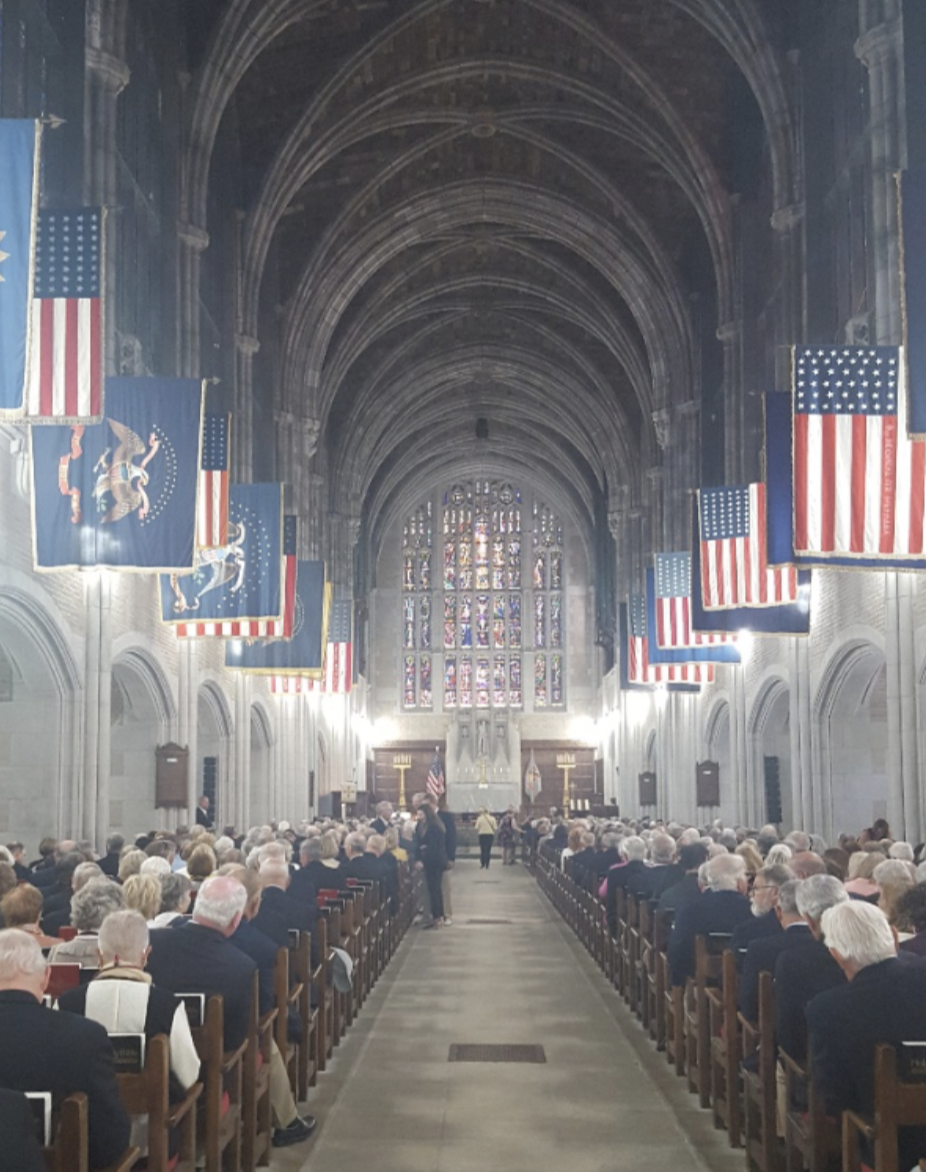
Memorial Service in West Point
Memorial Service in the Cadet Chapel

(Over 800 classmates and family members assembled from all over the world for the 50th reunion.)

Written by Suzanne Rice · Categorized: By Jim Russell

May 01 2019

A Semi-final Resting Place, Part 2 – 2018

Glen Ivey West Point 1969
Glen Ivey 1947-1972

San Marcos Cemetery, San Marcos, Texas: The San Marcos Cemetery is what I think of when I think of a cemetery. It was not large, nor was it flat, nor was it isolated, nor was it visible from the nearby main road. Rather it was secluded on a gentle knoll with lots of trees and simply lovely in every way. However, it did present one of the problems which I had always imagined might occur on the trip. As it turned out the cemetery had at least two family plots for people named Ivey. Whether they were related or not I never found out, but the information I had been given by the cemetery prior to leaving on my trip was for the wrong plot. I wasn’t too worried when I was the first to arrive and discover the error. I knew that Karl Ivey had been there the day before so I expected that he could set us straight once he arrived, and in any case a nearby cemetery worker was able to redirect me accordingly. As with the service the day before, the 15 of us at Glen Ivey’s service was also under a scorching sun, and although there were trees everywhere, they were not spreading out over Glen’s grave. Of the twelve services that I ended up doing, over half of them were on days that were quite warm. But true to form, Texas laid claim to being supreme by having the hottest weather of all. To read Glen Ivey’s Memorial Article click here.


Remembering Guy Hester
Guy Hester 1945-1970

Oakwood Cemetery, Winona, Mississippi: I tend to suffer from an obsessive-compulsive tendency. I say suffer because that is my wife’s claim. My claim is I am meticulous. It is why I tried my hardest to get as much information as I possibly could from the cemetery offices before ever leaving my home in Connecticut. I already mentioned that in one case I was sent the wrong information. In the case of Oakwood, I was sent no information at all. However, I knew that Guy Hester’s widow, Elsie Lynn, would be present so I did not fear being unable to find Guy’s grave when the proper time came. Though I was not able to visit all the cemeteries the day before, when I had the chance I did try to, and Oakwood was no exception. I drove up and down the lanes looking for a Hester family headstone, but to no avail. The next day when I and the almost 30 others arrived for the service, Elsie Lynn was there and the headstone was easy to spot, but I never saw it. There were a number of times when my obsessive-compulsive nature proved insufficient to the task, but God never did. To read Guy Hester’s Memorial Article click here.

James LeRoy Smith West Point
James LeRoy Smith 1944-1971

Blue Ridge Memorial Gardens, Beckley, West Virginia: If you have never been to West Virginia you need to do yourself a favor and visit it. In some respects, it is like no other state I know. If you are not going up the side of a hill or mountain you are going down, or vice versa. Which actually makes Blue Ridge Gardens a bit of an anomaly. Not that it doesn’t have any slopes, for it does to be sure, but it is not nearly as hilly as I might have expected. And as it turns out, Jim Smith’s grave is on a relatively flat portion of the cemetery in any case, which, of course made it easier on the 15-16 of us who attended. It is at least reasonably possible that I am one of the most experienced members of our class when it comes to trying to find specific graves in specific cemeteries. As a minister I have spent more than my fair share of time in them. I had fairly specific information. I knew that Jim’s grave was in the Everlasting Life Section, Site 39, Plot A3. And I had a map with an X marks the spot designation. But it still took some time to find it. I probably walked right by it several times before finally spotting it once and for all, but once I finally did it felt good. It was going to be the last time I would be responsible for finding a grave on my trip. The next time at Arlington that job would have already been done by somebody else. To read Jim Smith’s Memorial Article click here.

Arlington National Cemetery, Arlington, Virginia: In my post-trip after-action report I mentioned the special nature

Henry Schroeder West Point
Henry Schroeder 1947-1991

of being at Arlington National Cemetery. As a retired National Guard Chaplain, just being there was very special for me. But to be there to lead a memorial service for Hank Schroeder that would be attended by 45 classmates and spouses was almost beyond words. Even now as I try to write I find it much harder than for the paragraphs above. With those the words flowed easily, but for Arlington I am almost without words. Perhaps that is because from the top of my now-balding head to the bottom of my flat feet I am a military man. I was born at Fort Benning, Georgia, and raised on military bases all my life as a child. I probably heard the name Arlington National Cemetery before I ever really knew what it was or understood its significance. Even to this day I have not yet been able to give it the time and attention it deserves. The two times I have been there were both for very specific purposes, so I have not yet been able to visit as a tourist. I have yet to visit the Tomb of the Unknown Soldier, which I have to say is a bucket list item for sure. I do not have the credentials to be laid to rest there, but Lord willing I will see it again. To read Hank Schroeder’s Memorial Article click here.

West Point Cemetery, West Point, New York: I hope that what I am about to say is not considered sacrilegious. To my mind, the thing that makes the West Point Cemetery special is simply the fact that it is at West Point. That and of course the people that are buried there. As cemeteries go, it is not the most beautiful one I have ever been in. It is not the largest one. It is not the most well-kept one. Nor is it the most significant one. But it is the only one at West Point, and for that reason it has a specialness that no other cemetery can hold a candle to. There are many great people buried at Arlington, but there are great people buried in cemeteries all over our country. But West Point is like no other place, and those of us who were privileged to go there know that only full well. I was not a very special person before arriving at West Point, and I was not a very special cadet while I was there. I cannot speak for the twenty or so who attended, but just being a cadet made me feel special, and I have felt special ever since. B Arnold and the Traitors could sing, “We got to get out of this place!” with pure passion and truth, but every one of us knew we would never be able to get West Point out of us. And that is what makes the West Point Cemetery so special. For those like Joe Silva, Jon Shine, Pick King, Paul Sawtelle, John Woodrum, Harry Thain, Chip Oliver and Ken Yonan, who end up being buried there, it is like saying that when our time has come, we simply want to go home one final time.


 To read Joe Silva’s Memorial Article click here.

Joseph Silva West Point
Joseph Silva 1946-1970


To read Jon Shine’s Memorial Article click here.

Jonathan Shine West Point
Jonathan Shine 1947-1970


To read Pick King’s Memorial Article click here.

T. Pickett King West Point
T. Pickett King 1946-1971


To read Paul Sawtelle’s Memorial Article click here.

Paul Sawtelle West Point
Paul Sawtelle 1946-1971


To read John Woodrum’s Memorial Article click here.

John J. Woodrum West Point
John J. Woodrum 1947-1971


To read Harry Thain’s Memorial Article click here.

Harry Thain West Point
Harry Thain 1944-1972


To read Chip Oliver’s Memorial Article click here.

Frank G. Oliver West Point
Frank G. Oliver 1947-1972


To read Ken Yonan’s Memorial Article click here.

Kenneth Yonan West Point
Kenneth Yonan 1947-1972


Before I close, I would like to say a special thank you to all those who attended the twelve services. It was a great encouragement to see how selfless our classmates were in hosting me during my travels, and in taking the time to attend, as well. In several cases, former roommates and friends travelled great lengths to attend different services, whether from Washington, D.C. to Detroit and West Virginia, or from Florida and Texas and Chicago to Montana, or from various points of origin to Texas. At every service, there was at least one other classmate besides me in attendance, and often many more. It was also encouraging in three instances to see local folk turn out as well due to the event being publicized in hometown newspapers. All in all, it was one of the most rewarding things I have ever done in my life and ministry.

A Semi-Final Place: I titled this piece “A Semi-Final Place”. Obviously, I did so with a distinct purpose in mind. It is because no cemetery is the final resting place for anyone. The Bible teaches us that all souls will one day all be raised from the dead … the just and the unjust alike. No one who has ever lived will remain in the place where they were laid to rest. Even those who due to some misfortune or another did not have the luxury of a “final resting place” will be raised from the dead. According to God’s perfect plan there will come a day when everyone’s soul will be reunited with their body. The fact of the bodily resurrection from the dead is part of the declared purpose and plan of God. In fact, there will be two resurrections, and not just one. And as Revelations 20:6 says, “Blessed and holy are those who attain to the first resurrection.”

Written by Suzanne Rice · Categorized: By Ray Dupere

  • « Go to Previous Page
  • Page 1
  • Interim pages omitted …
  • Page 37
  • Page 38
  • Page 39
  • Page 40
  • Page 41
  • Interim pages omitted …
  • Page 49
  • Go to Next Page »

Footer

Historians and other inquiries.

Submit a Form

Join our community.
Subscribe to Our Bulletin

Copyright © 2026 · Site by RK Studios